-

Introduction
-

Causes: Recruiting on Campus and Demonstration Restrictions

-


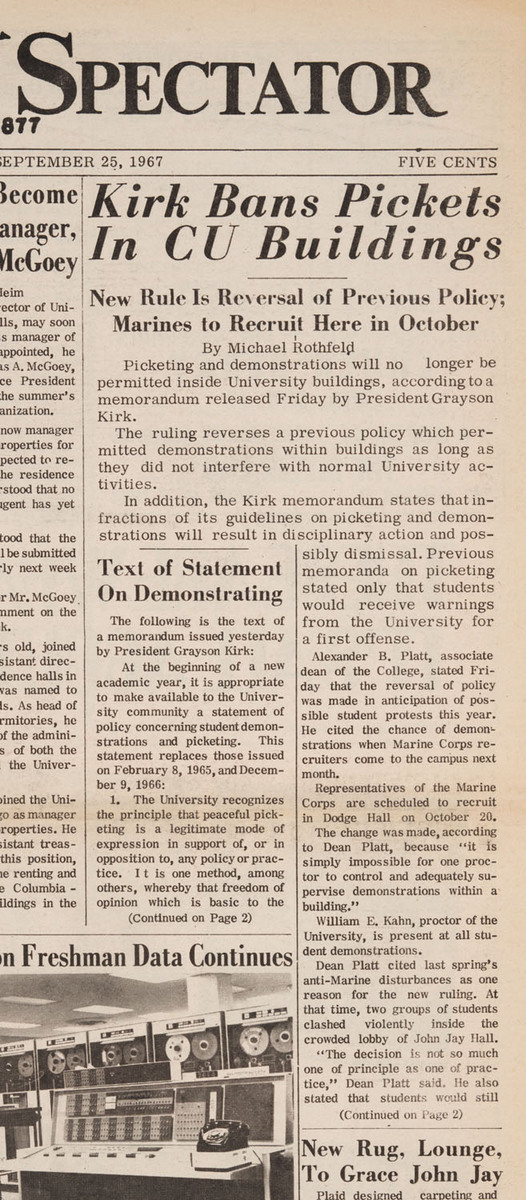
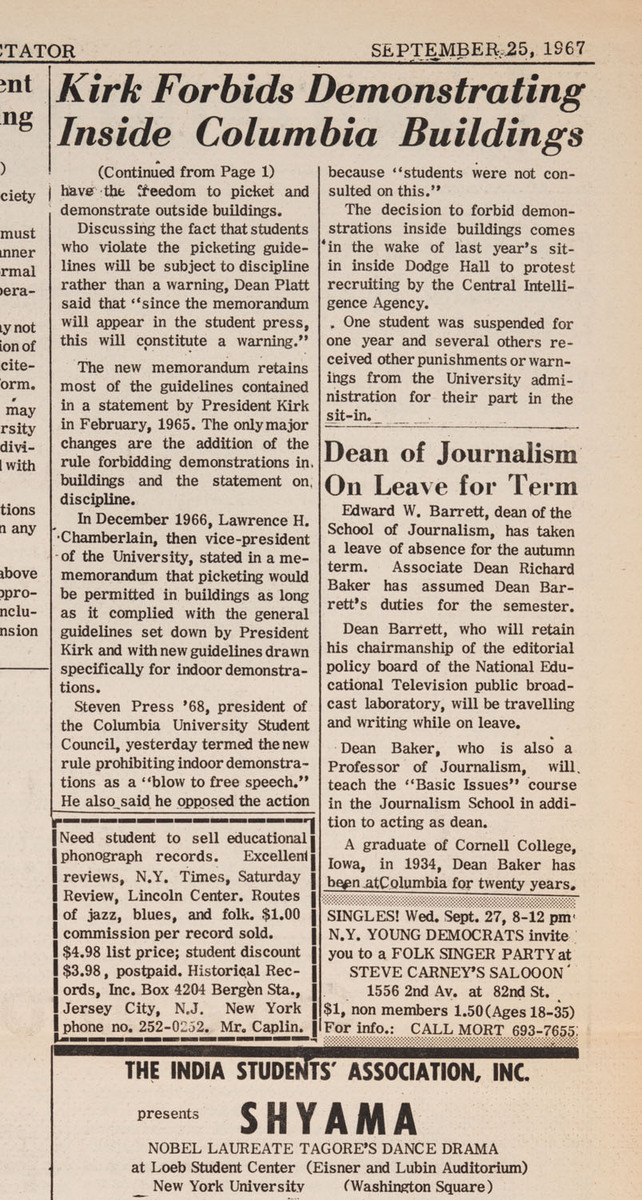
"Kirk Bans Pickets in CU Buildings: September 25, 1967 "
-
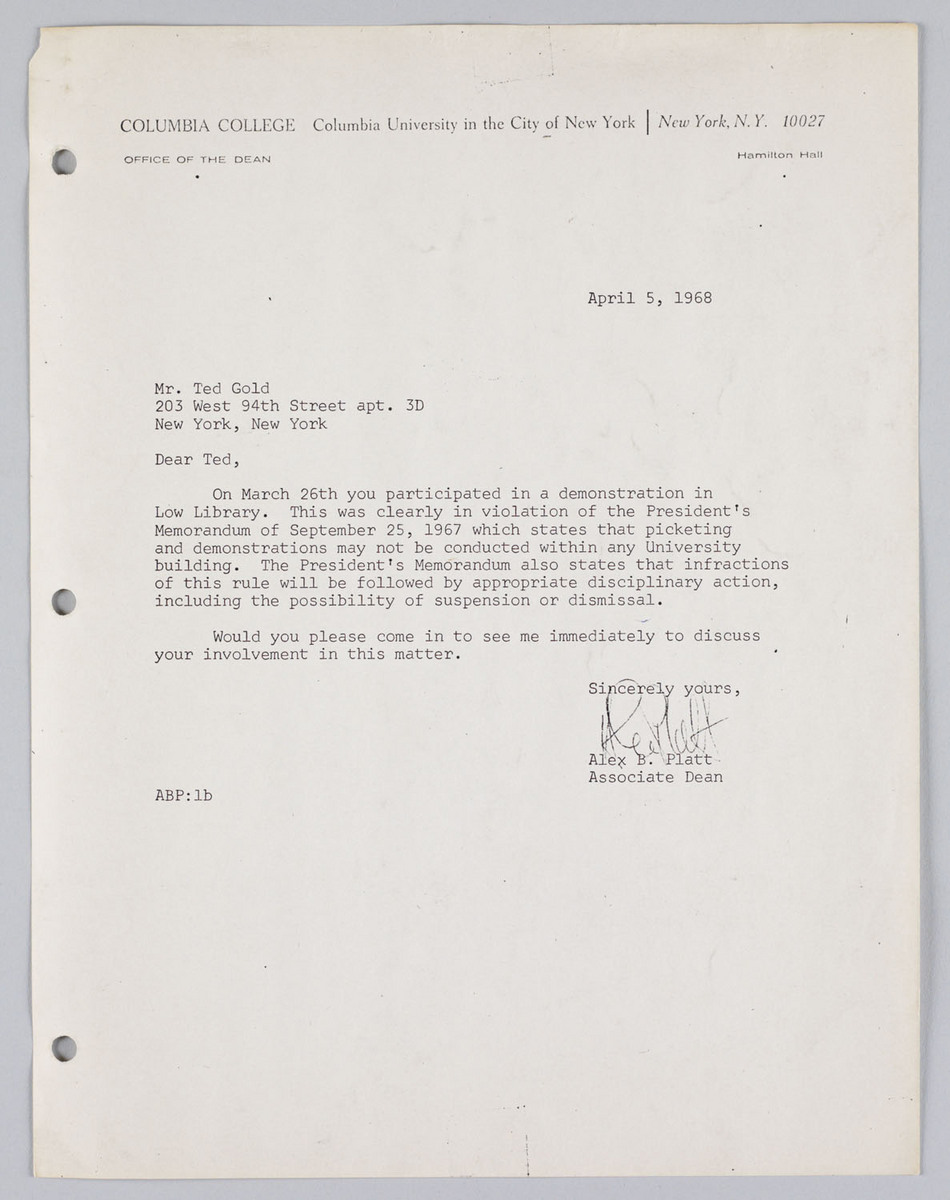
Associate Dean, Alex B. Platt to Columbia College student Ted Gold, April 5, 1968
-
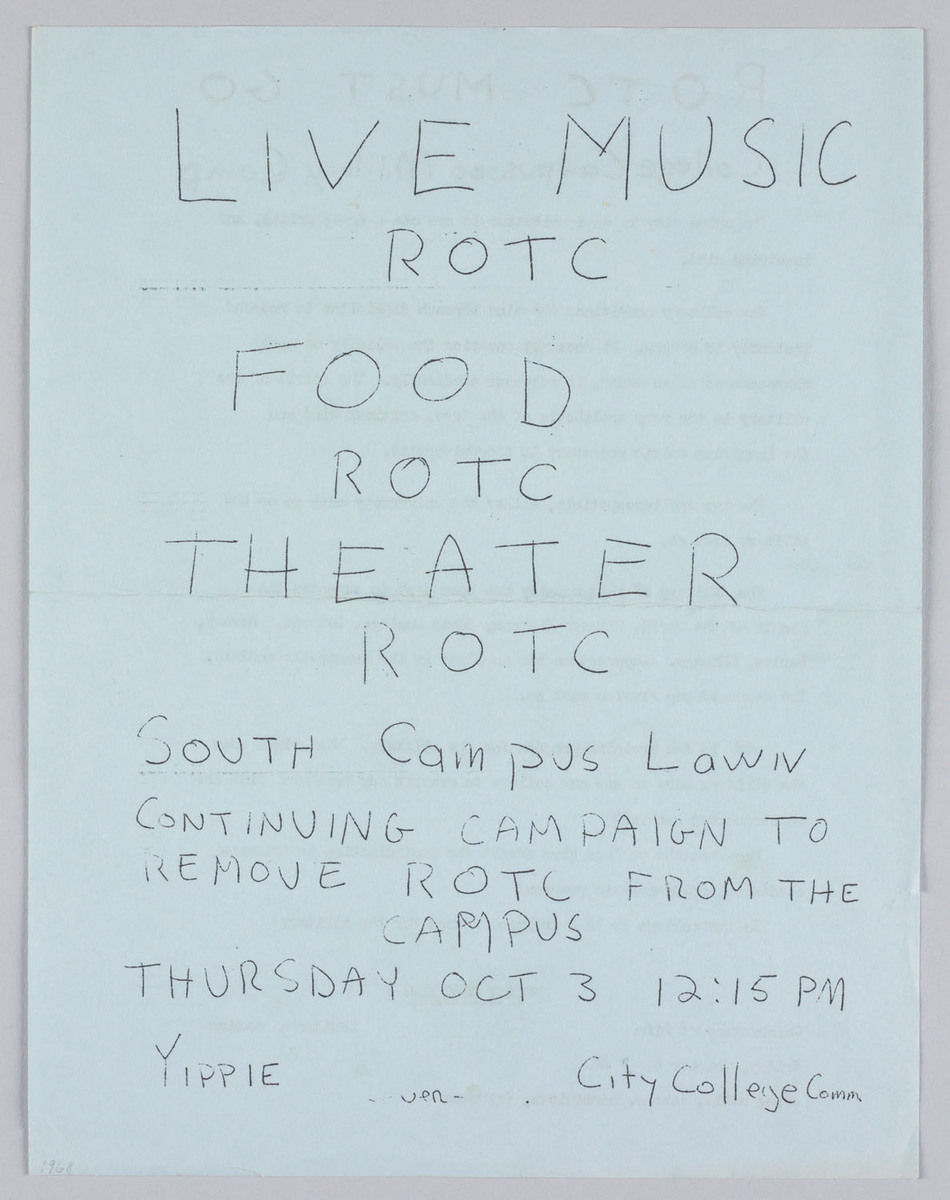
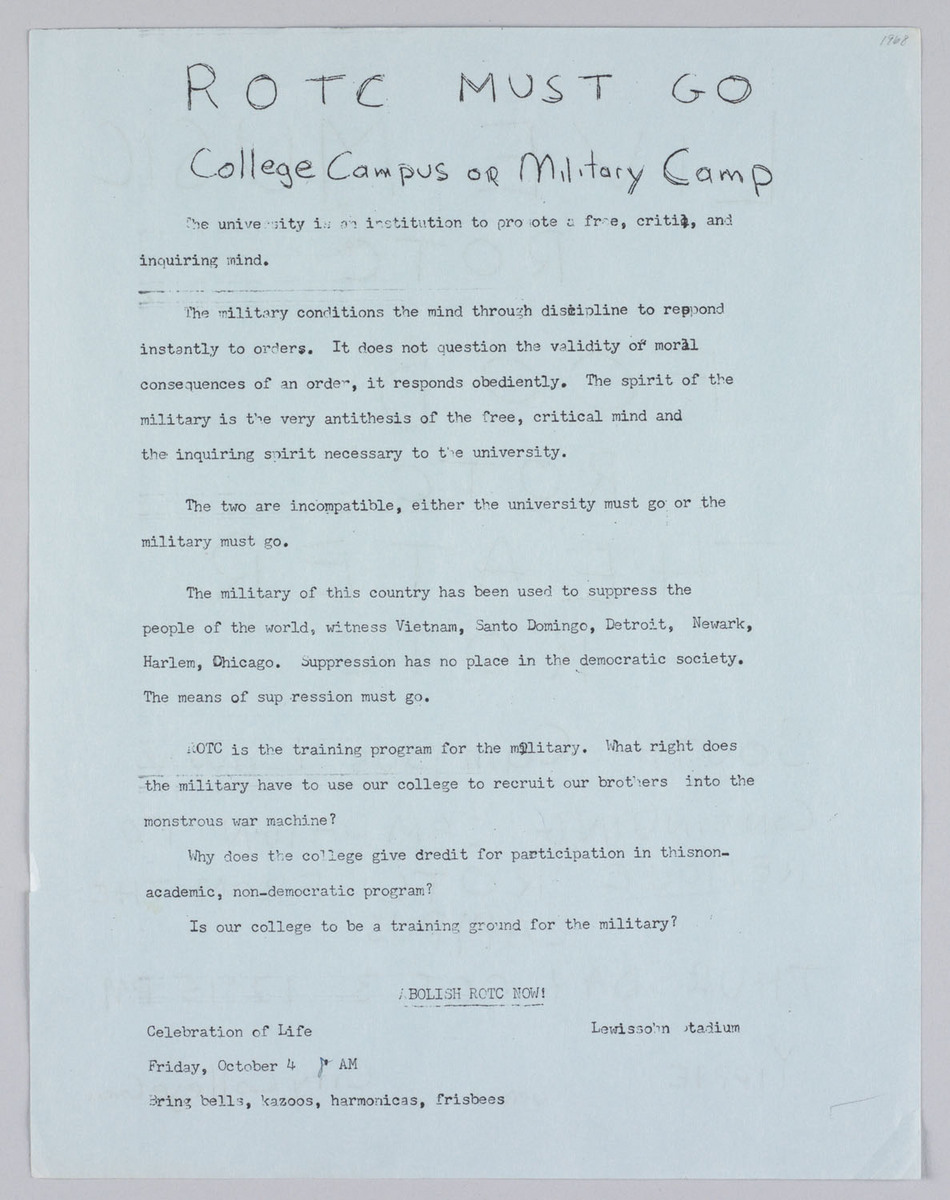
"Live Music, ROTC, Food, ROTC, Theater, ROTC"
-
-
Timeline of Events
-
Tuesday April 23
-
Wednesday, April 24
-
THURSDAY, April 25
-
FRIDAY, April 26
-
SATURDAY, April 27
-
SUNDAY, April 28
-
MONDAY, April 29
-
TUESDAY, April 30
-
-
The First Day - April 23, 1968
-
Brochure: "The New Gymnasium"
-
Crowds heading to Low Library
-
Original calendar of events
-
Circular: "Tired? Tired? Tired?"
-
Defend the Right to Demonstrate
-
Our Demands
-
Join Us!
-
Dean Henry Coleman
-
-
SAS Occupation of Hamilton Hall
-
Brochure: "The New Gymnasium"
-
Interior of Hamilton Hall during the occupation.
-
Food pantry inside Hamilton Hall during the occupation.
-
Students inside occupied Hamilton Hall
-
Dean, Alex B. Platt to Columbia University students in Hamilton Hall
-
H. Rap Brown reading Hamilton Hall statement
-
Statement from black students occupying Hamilton Hall
-
-
Causes: Institute for Defence Analysis
-
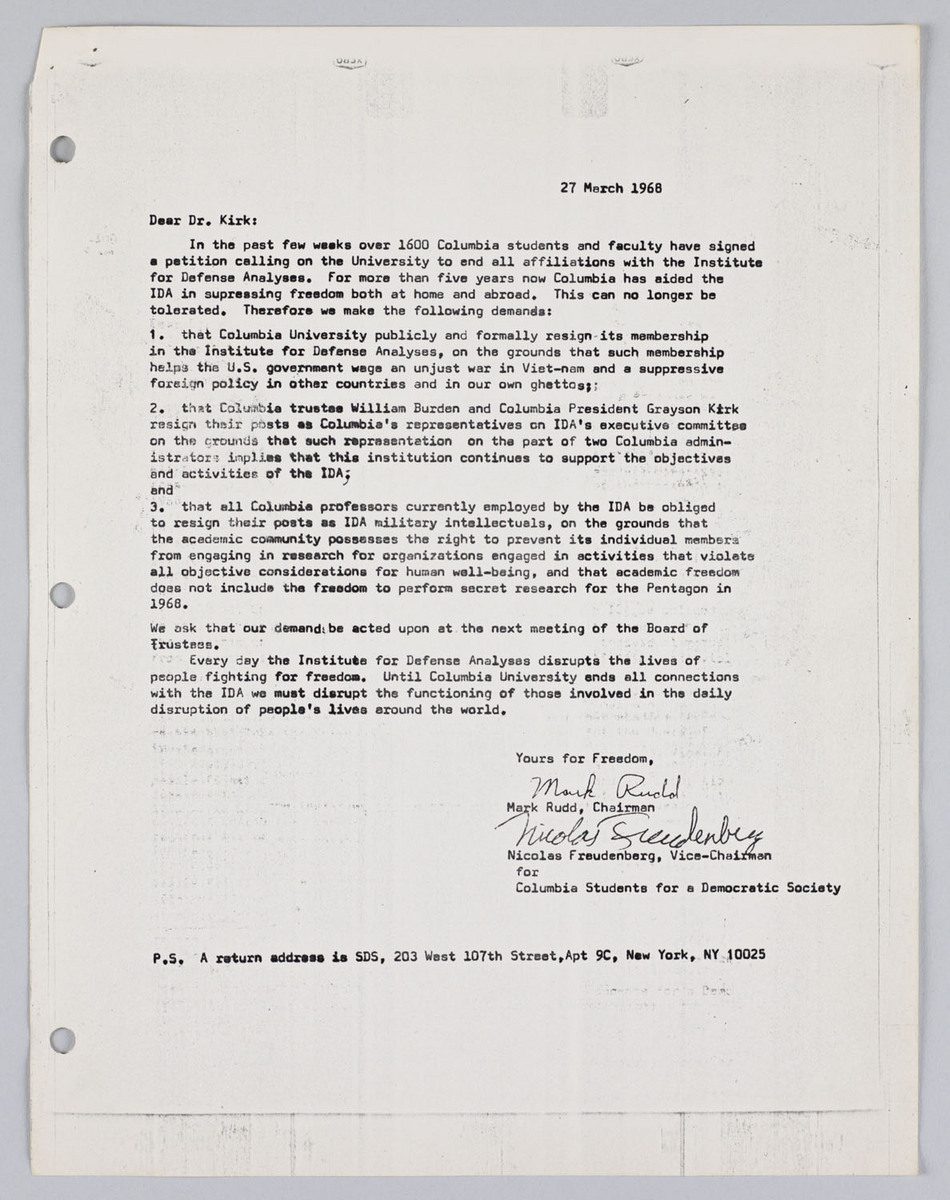
Letter from Rudd and Freudenberg to Kirk
-
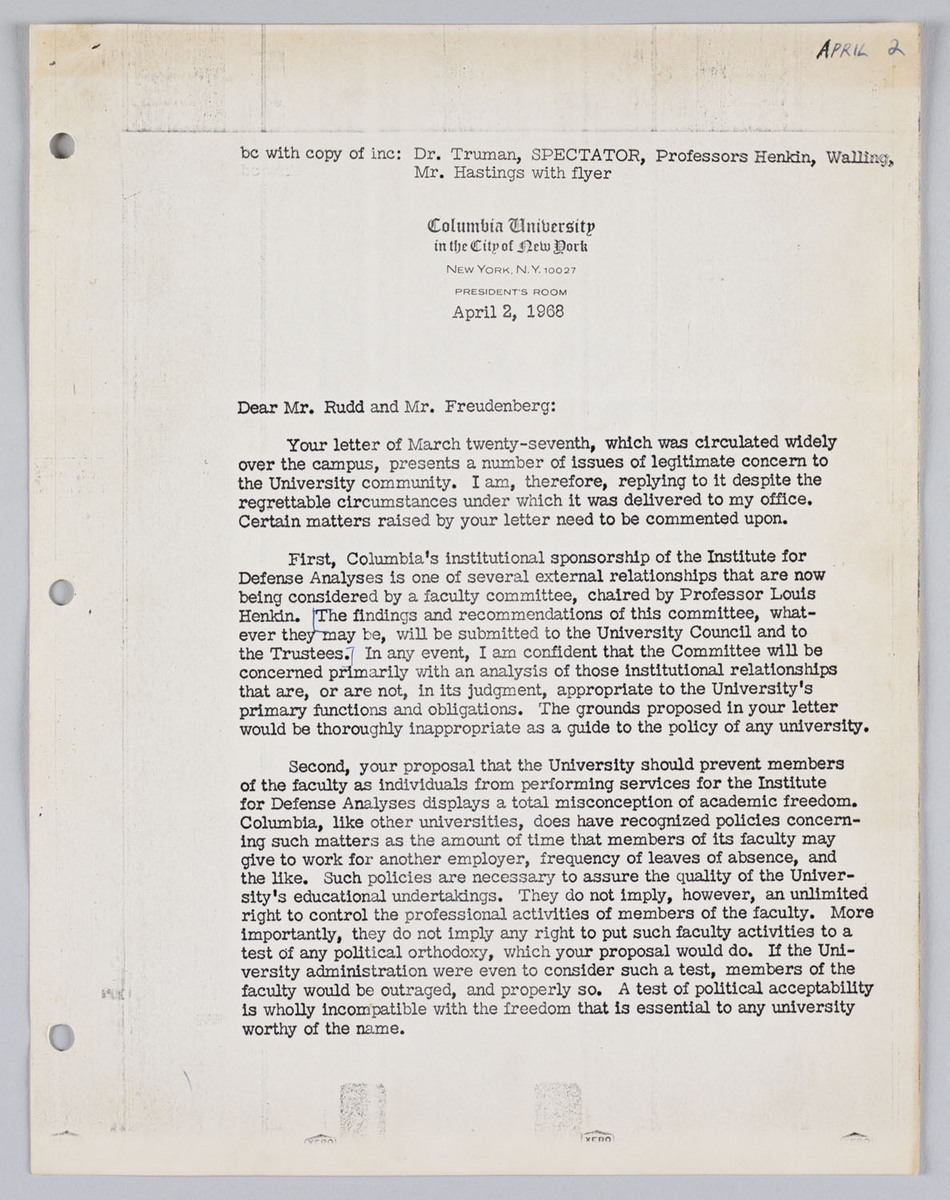
April 2, 1968 letter from President Kirk in response to Rudd and Freudenberg.
-
Protestors tearing down protective fencing
-
-
Causes: Morningside Park Gymnasium
-
Protestors tearing down protective fencing
-
Brochure: "The New Gymnasium"
-
-
Causes: Society of Afro-American Students (SAS)
-
"Stop Columbia's Gym Crow"
-
-
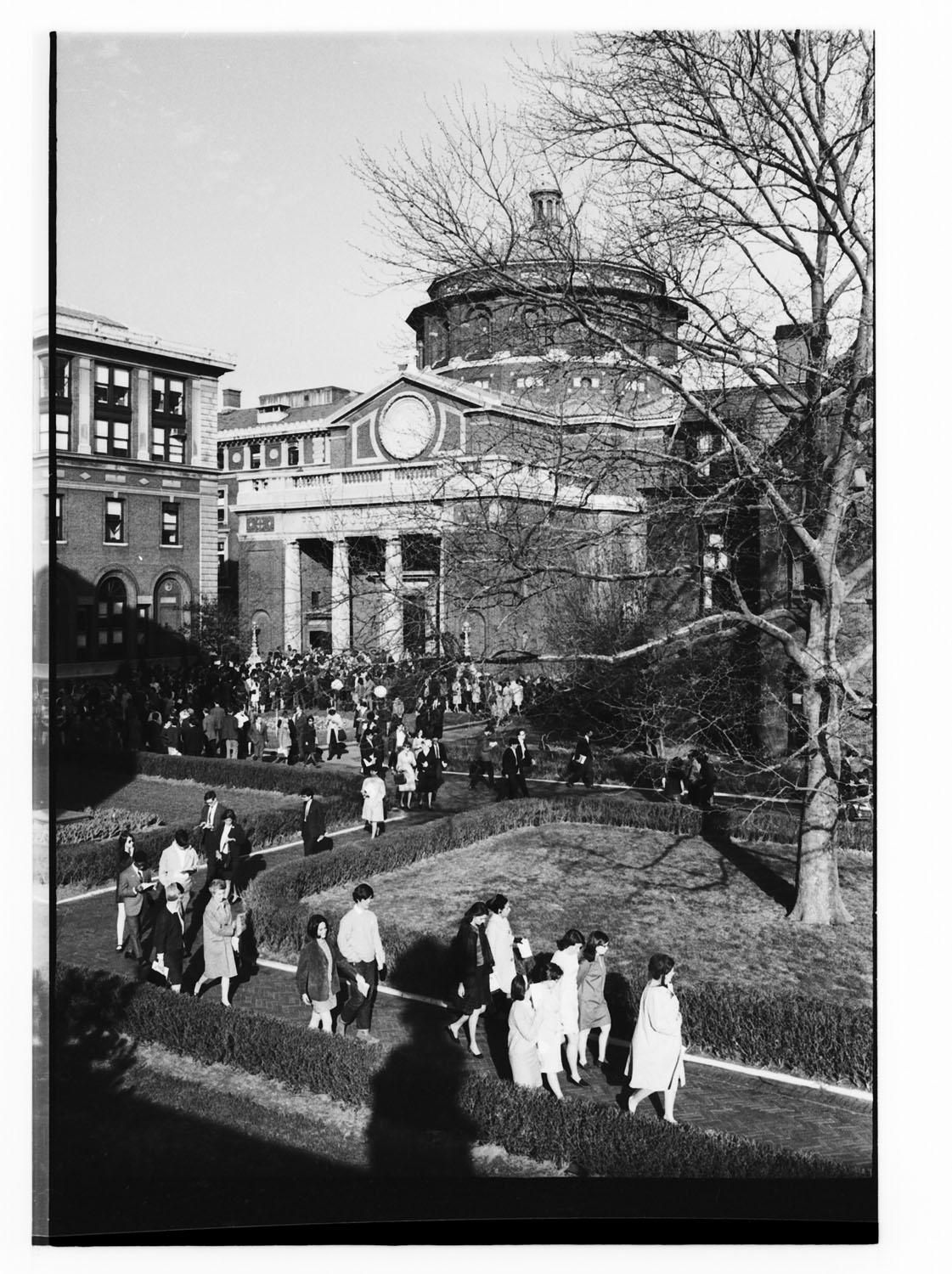
Causes: Martin Luther King, Jr. Memorial Service
-
Button: "I Have a Dream," 1968. Courtesy of Frank da Cruz, '71GS, '76E
-
Crowds Leaving MLK Memorial Service
-
The King Memorial - Why We Disrupted, p. 3
-
-
Causes: Students for a Democratic Society (SDS)
-
Mark Rudd and other SDS leaders at a Strike Coordinating Committee Press conference
-
Reply to Uncle Grayson
-
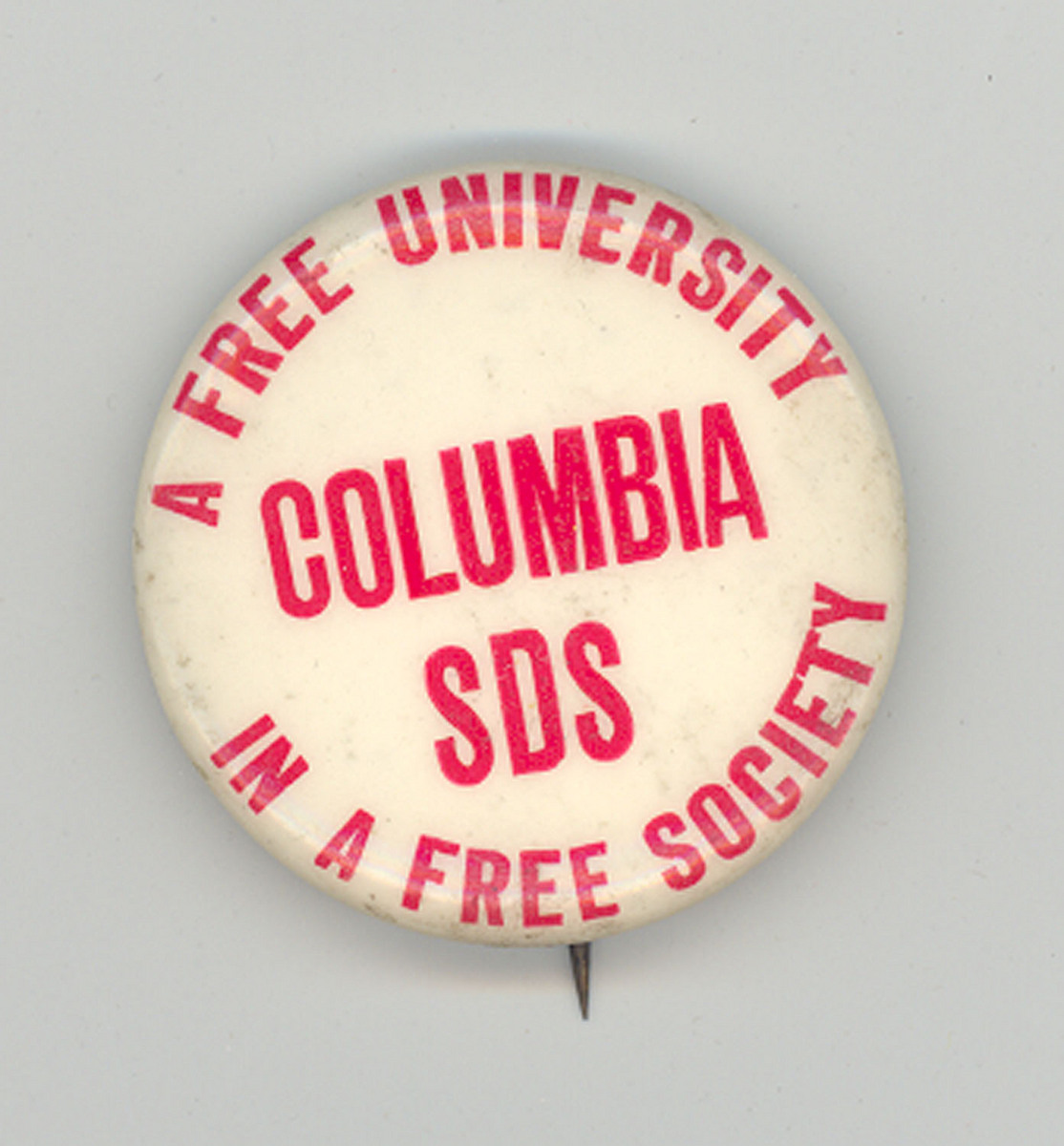
SDS button
-
-
The Bust
-
Button: "I Have a Dream," 1968. Courtesy of Frank da Cruz, '71GS, '76E
-
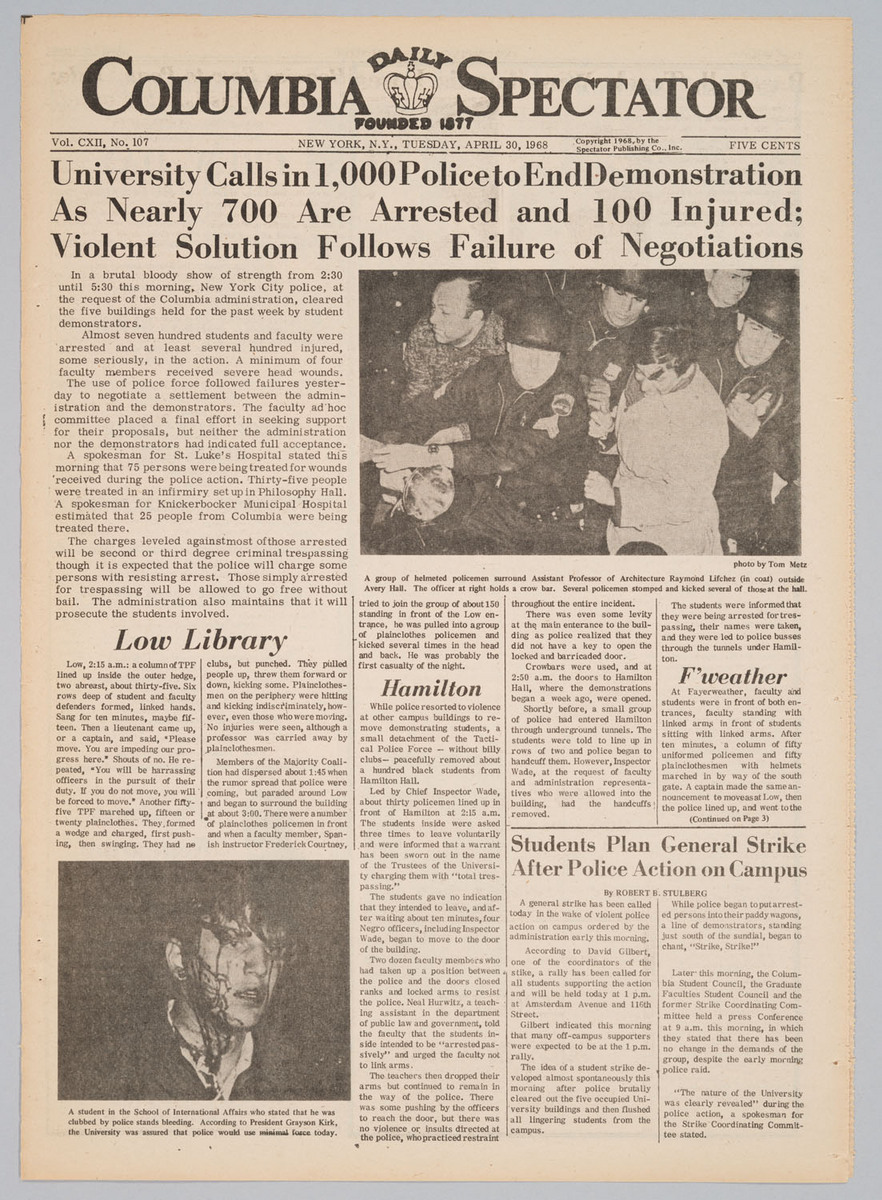
Columbia Daily Spectator, April 30
-
Students being chased by police
-
After the police bust
-
-
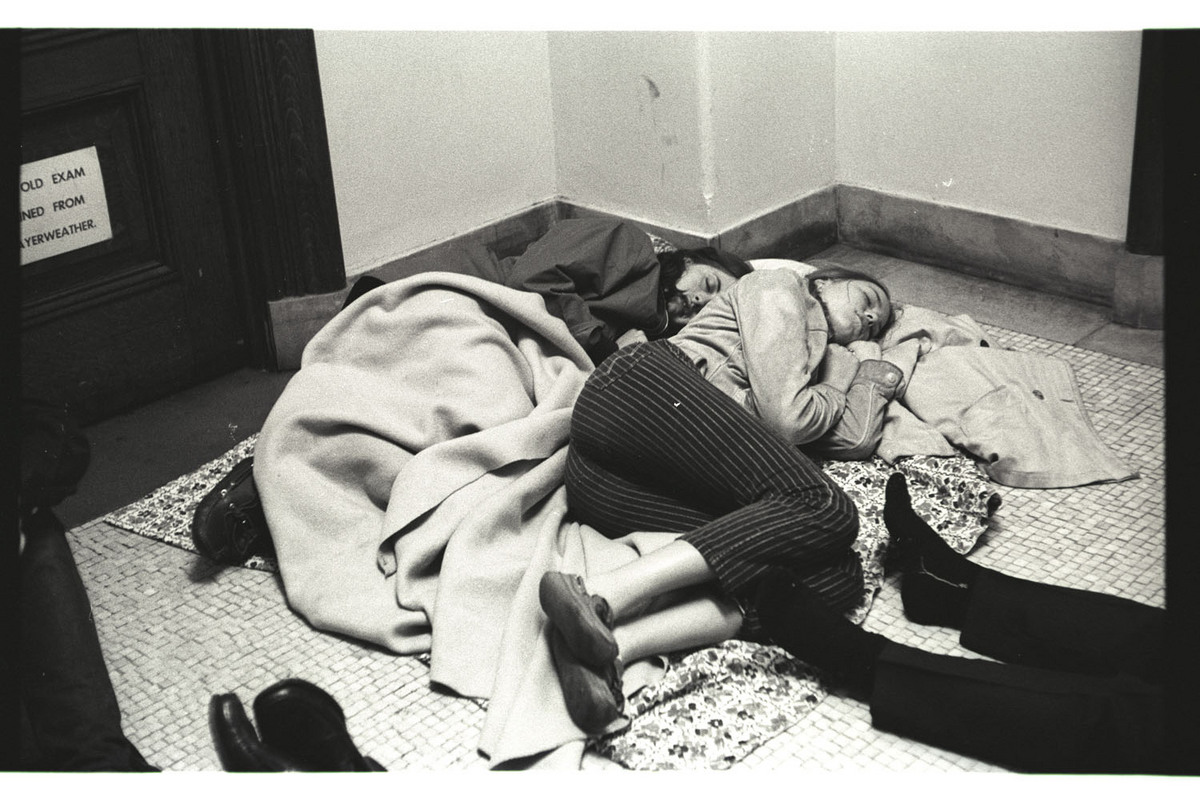
The Protests: Women's Involvement in the Strike
-
"Kirk Bans Pickets in CU Buildings: September 25, 1967 "
-


Suggested Donation Levels
Congratulations!
You scored:
x
x
What have you learned?
"Kirk Bans Pickets in CU Buildings: September 25, 1967 "
On April 21, 1967 the first student-to-student clash erupted when 500 students favoring the policy of open recruitment on campus confronted 800 anti-recruitment demonstrators. Student disruption of military recruiters prompted University President Grayson Kirk to issue a ban against picketing and demonstrations inside all University buildings as of September 1967.
Related Items




Associate Dean, Alex B. Platt to Columbia College student Ted Gold, April 5, 1968
In March 1968, SDS defied this policy, staging a demonstration inside Low Library demanding Columbia’s resignation from IDA. Despite limited enforcement of his ban on indoor demonstrations prior to this event, President Kirk placed six of the 150 anti-war student activists – all SDS leaders later known as the “IDA Six” – on disciplinary probation. One of the principal demands that SDS promoted at the April 23rd Sun Dial rally was amnesty for the “IDA Six.”
"Live Music, ROTC, Food, ROTC, Theater, ROTC"
Blue circular, hand written advertising campaign to remove ROTC from college campuses
Tuesday April 23
TUESDAY APRIL 23
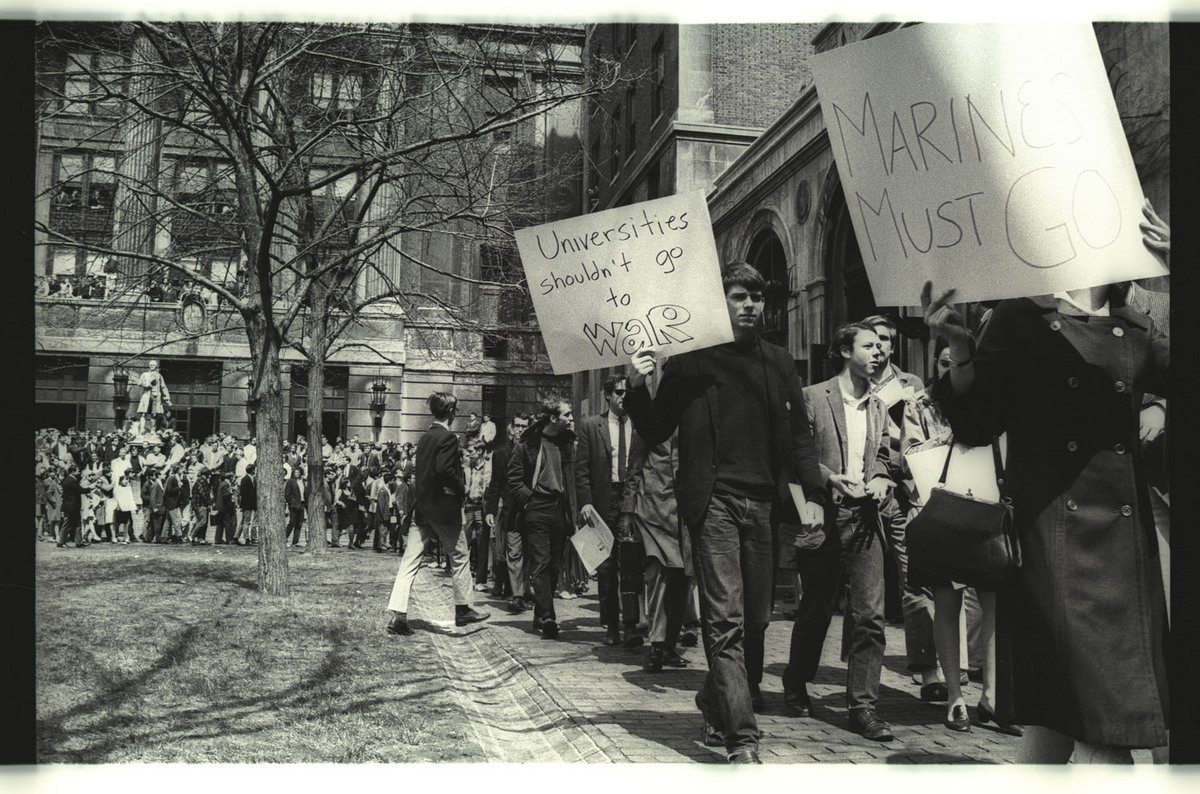
Noon SDS Sundial Rally
12:40 p.m. March on gymnasium site, Morningside Park
2:00 p.m. Sit-in begins in Hamilton Hall; Dean Henry Coleman restrained from leaving his office by protesting students
2:50 p.m. Six Demands forumlated; students decide not to leave until demands are met
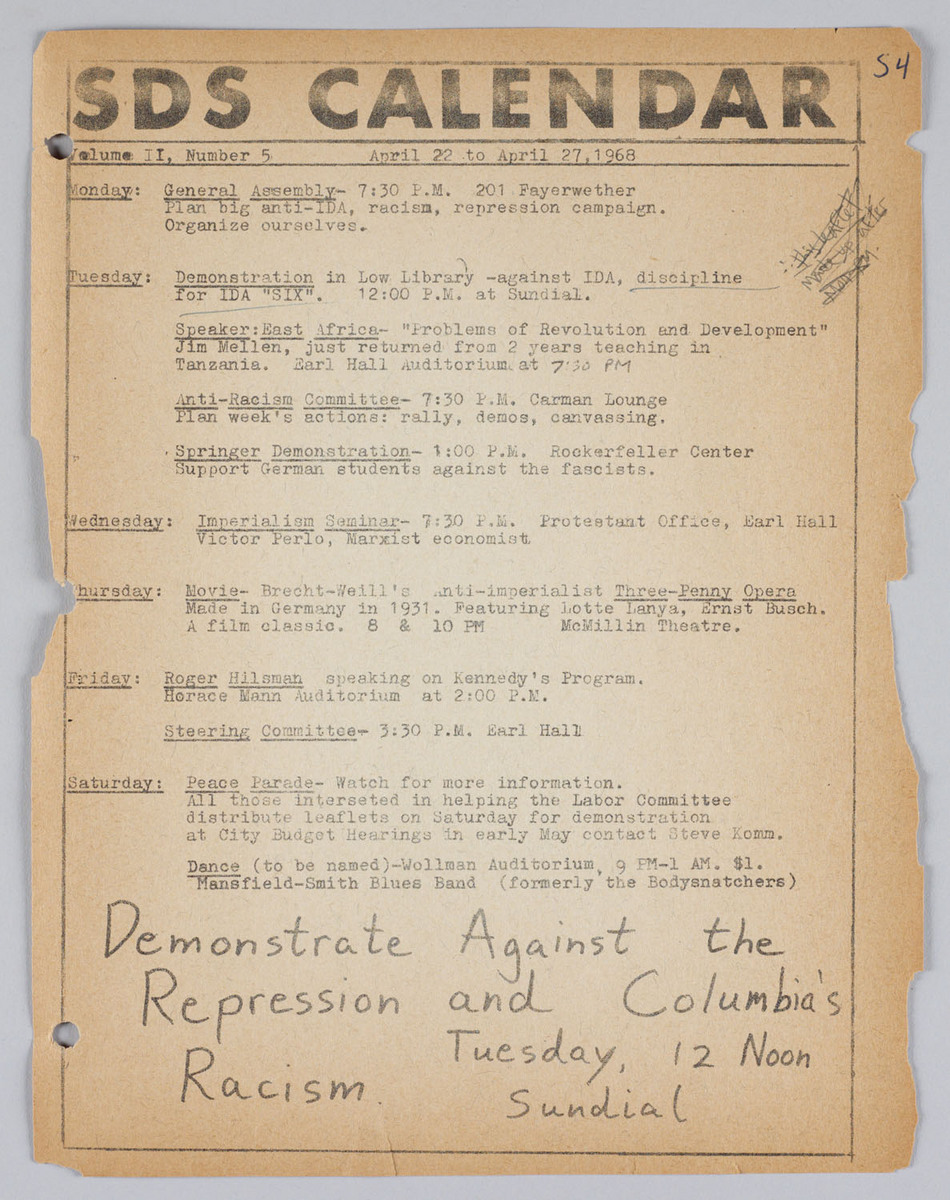
Original calendar of events proposed by SDS for the week of April 22 to April 27, 1968.
Wednesday, April 24
WEDNESDAY April 24
5:30 a.m. White students evicted from Hamilton Hall by black students
6:15 a.m. Students break into Low Library and seize President Kirk's offices
10:00 a.m. Faculty with offices in occupied Hamilton Hall begin congregating in 301 Philosophy Hall
3:30 p.m. Dean Coleman released from Hamilton Hall and goes directly to the Faculty meeting being held in Havemeyer Hall
8:00 p.m. Administration makes unsuccessful compromise offer to black students
Evening Avery Hall occupied by architecture graduate students who refused to vacate the premises.
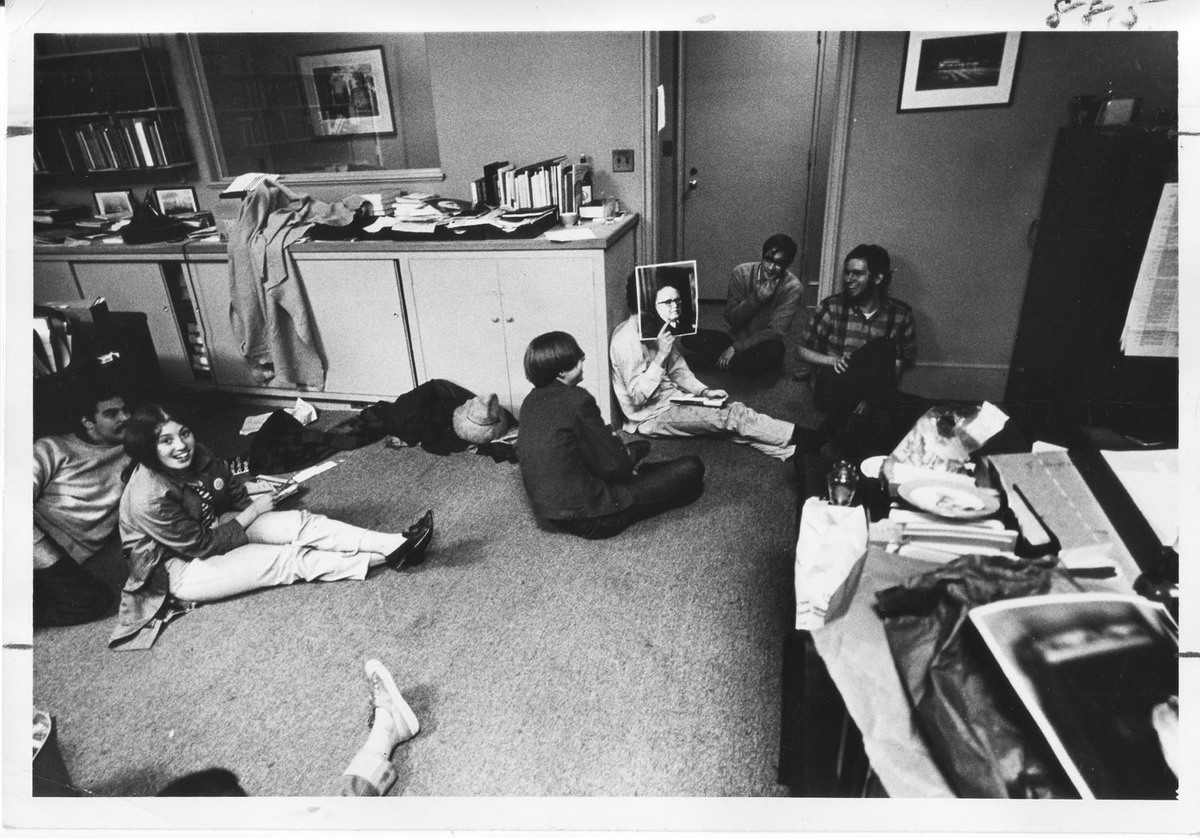
Students occupying President Kirk's office
Courtesy of Columbia College Today, Larry Mulvehill, photographer, 1968
THURSDAY, April 25
THURSDAY, April 25
2:00 a.m. Fayerweather Hall occupied by students from the graduate faculties, mainly from the social sciences
4:00 p.m. Formation of the Ad Hoc Faculty Group; formulation of its first proposals to end demonstrations
7:00 p.m. - 8:00pm Strikers reject Ad Hoc Faculty proposals
8:00 p.m. Harlem activists address rally at Columbia gates, march across campus
Evening Counter-demonstrators are dissuaded by Ad Hoc Faculty Group members from attempting to invade Fayerweather Hall
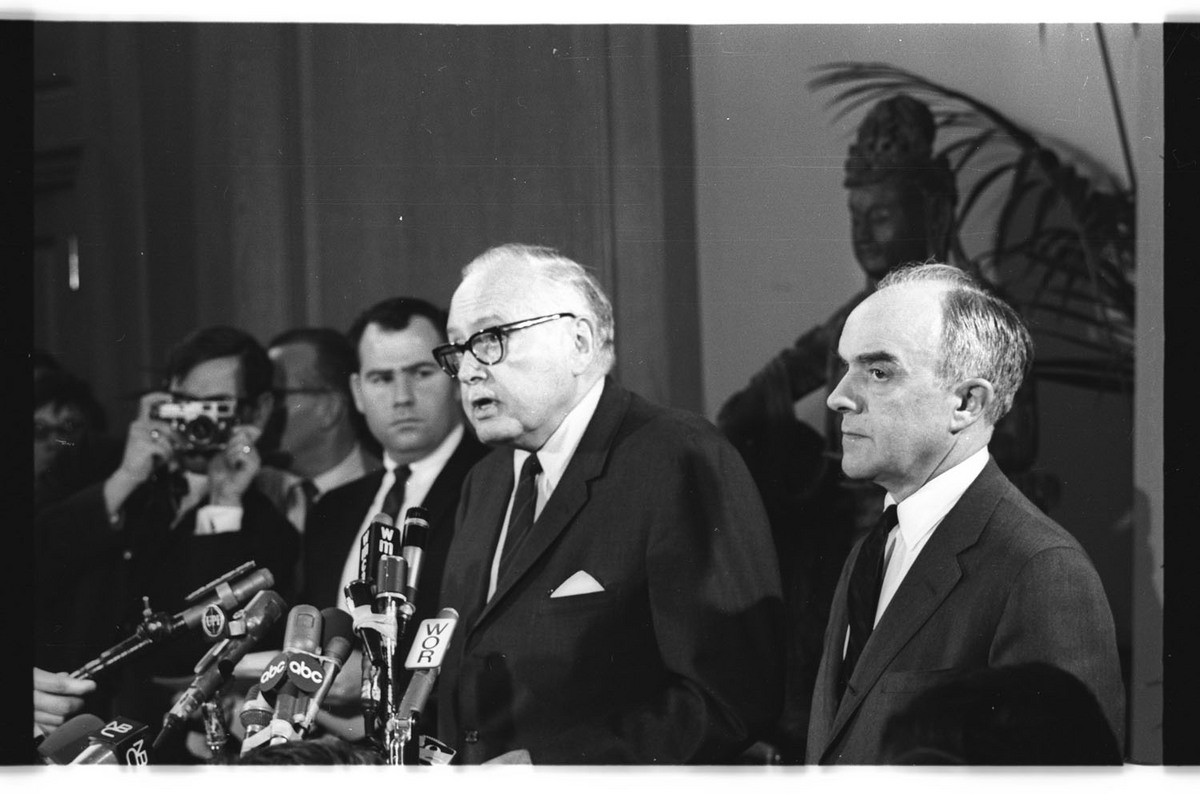
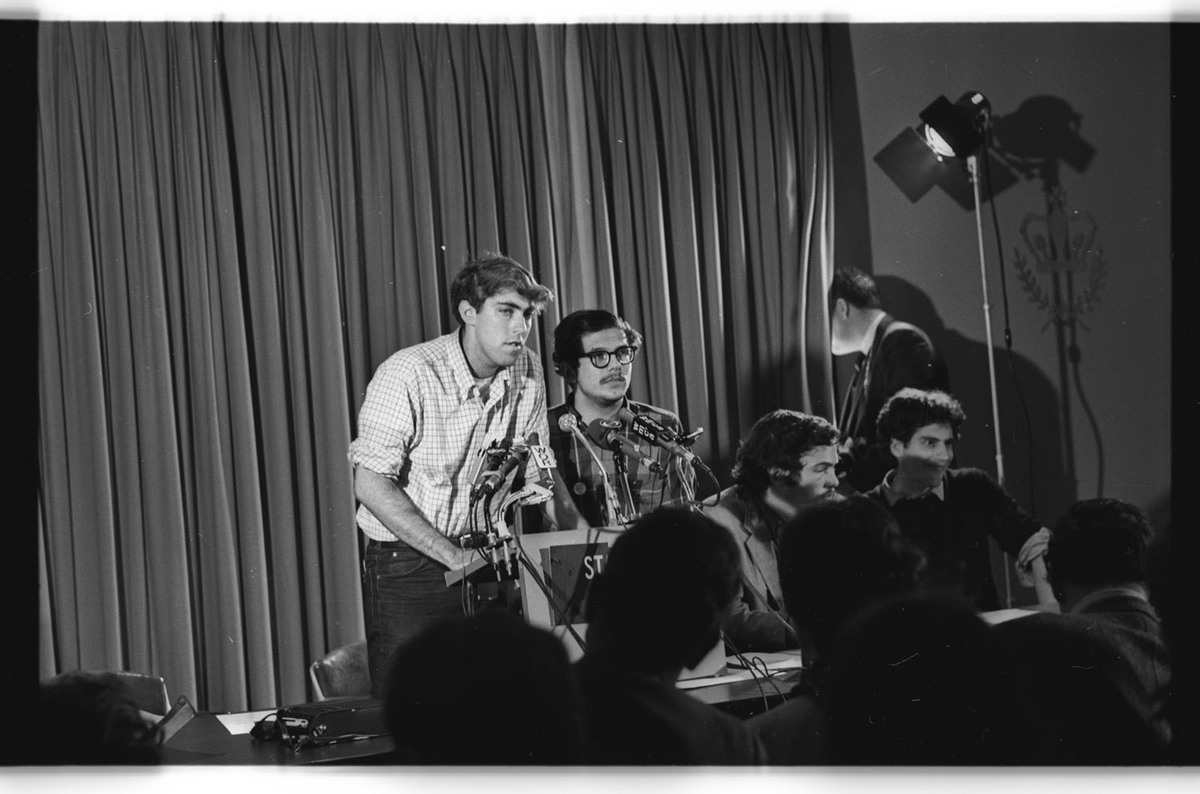
Grayson Kirk and David Truman at press conference in the Faculty Room of Low Memorial Library, April 25, 1968
Related Items
FRIDAY, April 26
FRIDAY, April 26
1:05 a.m. Provost Truman announces impending police action to Ad Hoc Faculty Group
1:05 a.m. Mathematics Hall occupied by radical/hard line students from Low and Fayerweather
3:20 a.m. As a result of strong faculty opposition, Truman announces police action canceled; gym construction suspended
1:10 p.m. H. Rap Brown and Stokley Carmichael enter campus
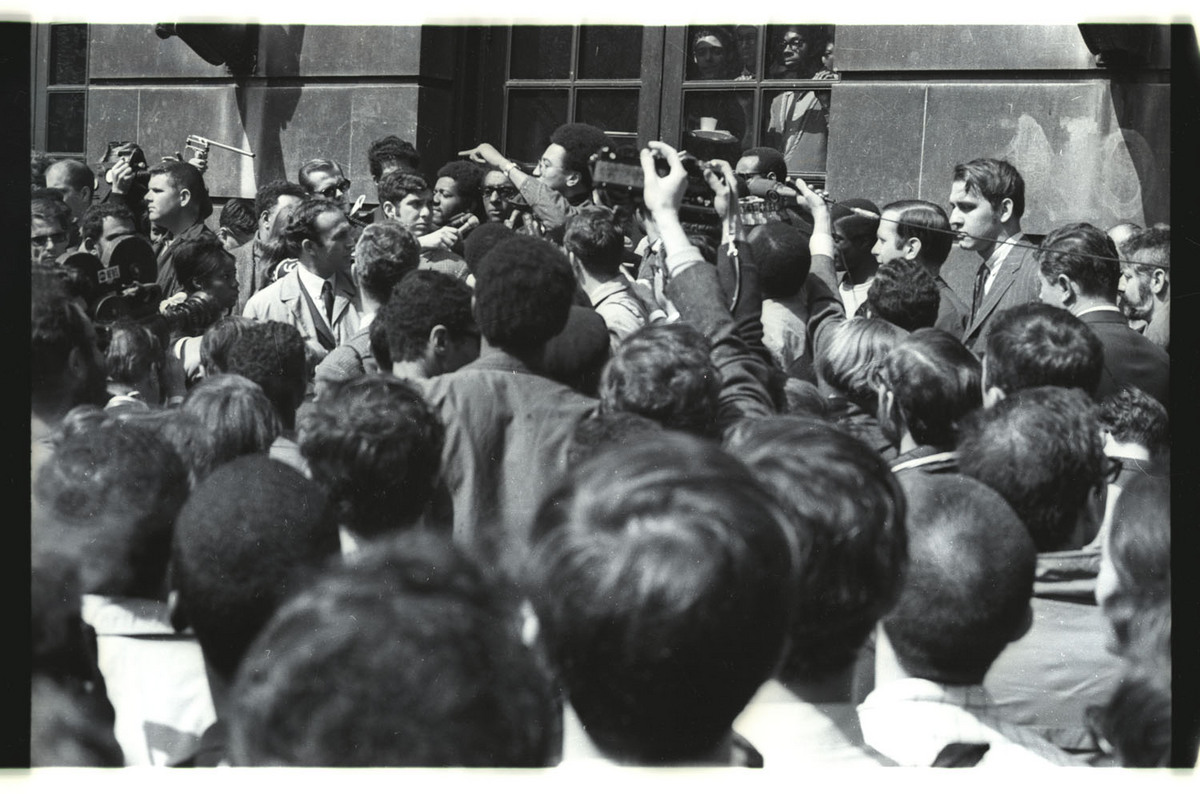
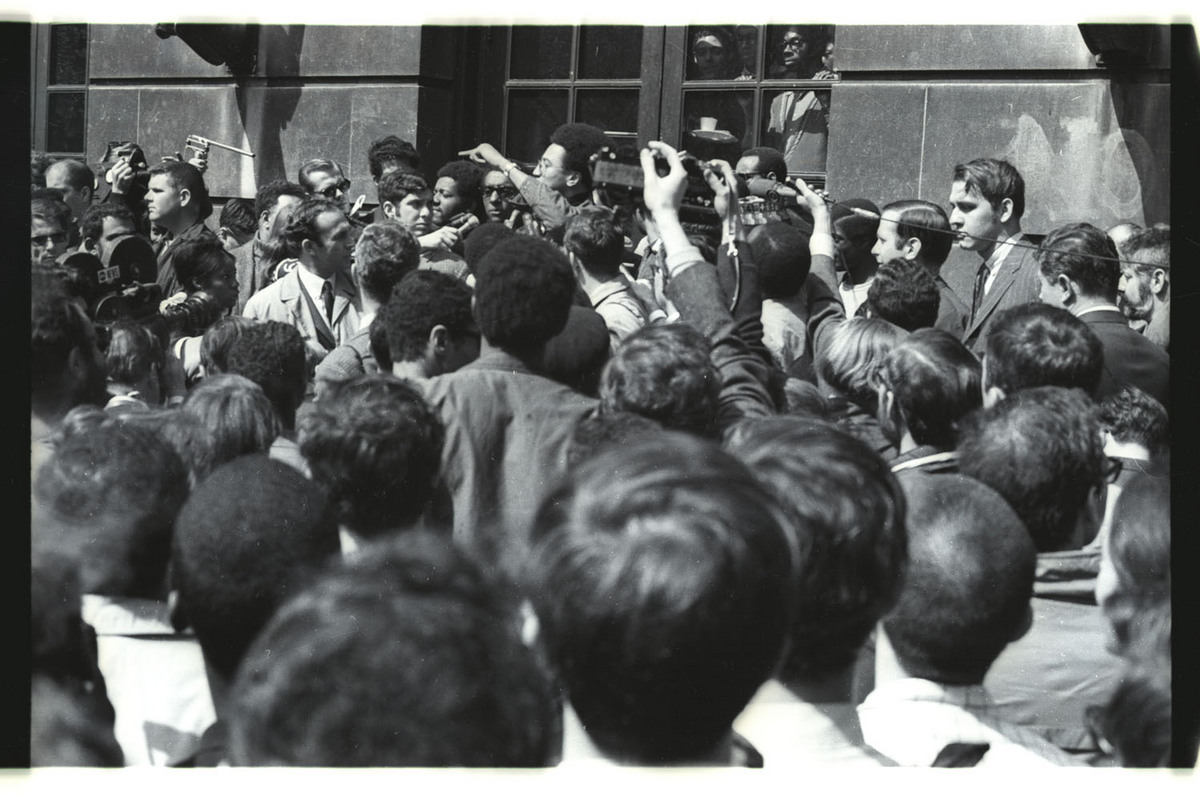
H. Rap Brown reading Hamilton Hall statement, Friday, April 26, 1968
Courtesy of Lee T. Pearcy '69C
SATURDAY, April 27
SATURDAY, April 27
1:00 a.m. Mark Rudd delivers "bullshit" speech before Ad Hoc Faculty Group, rejecting their efforts at mediation that does not include amnesty for striking students
Morning. William Petersen, chairman of the Trustees, releases a hard line statement regarding the situation on Columbia's campus
11:30 a.m. Faculty cordon around Low Library established to prevent access to demonstrators
Faculty members talking to students occupying Low Library.
SUNDAY, April 28
SUNDAY, April 28
8:00 a.m. Ad Hoc Faculty Group announces final resolution ("bitter pill") to end crisis
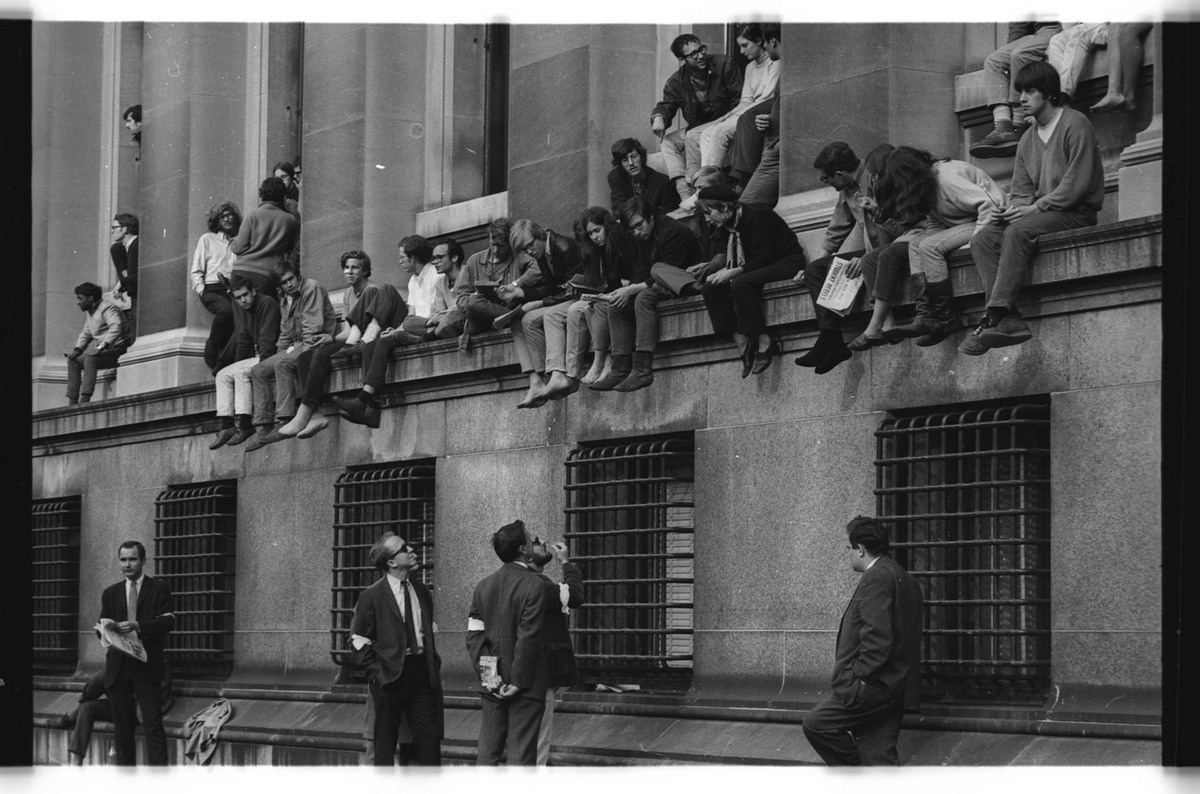
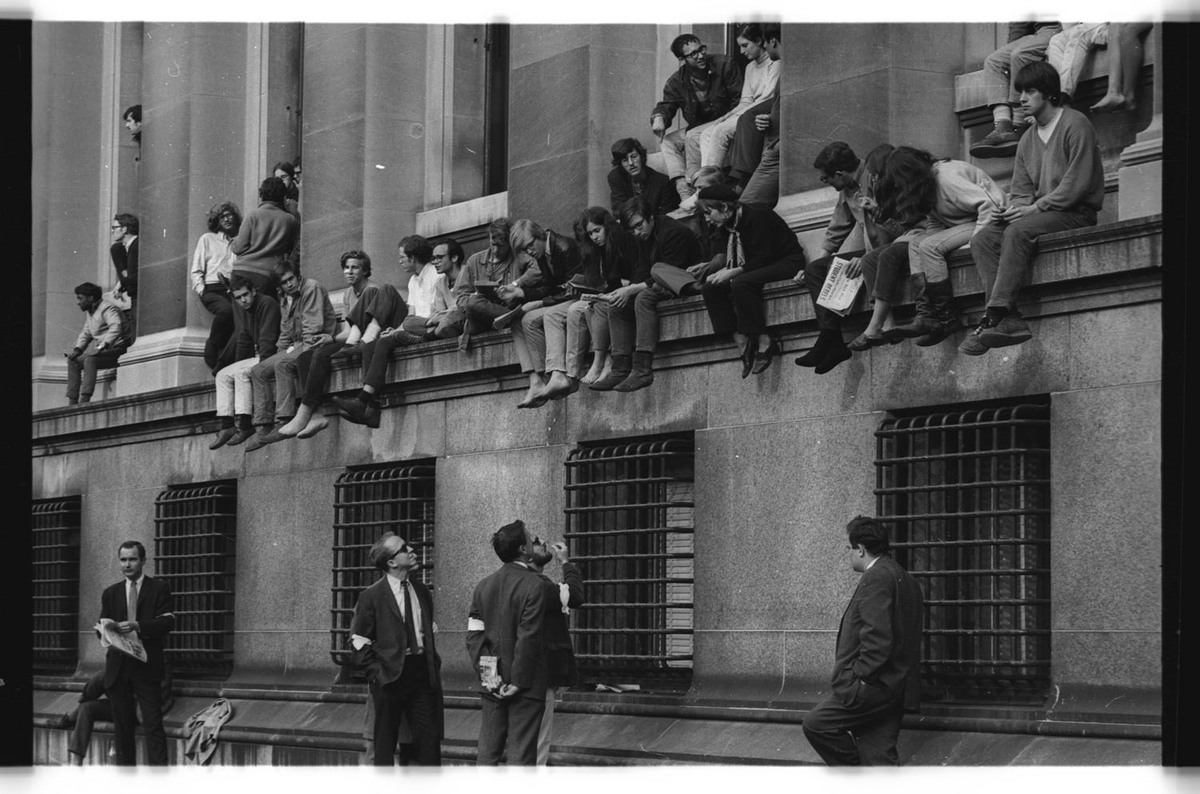
5:00 p.m. Majority Coalition establishes cordon around Low Library
Evening Demonstrators attempt to pass food through counter-demonstrators' cordon into Low Library
In this image the faculty members wear white armbands, the Majority Coalition members wear light blue armbands and sole occupying student on the building ledge wears a red armband.
Courtesy of Columbia College Today
MONDAY, April 29
MONDAY, April 29
3:30 p.m. President Kirk issues negative response to "bitter pill" resolutions
6:30 p.m. Strikers reject "bitter pill" resolutions
11:30 p.m. Ad Hoc Faculty Group appeals to Mayor Lindsay, tables amnesty motion
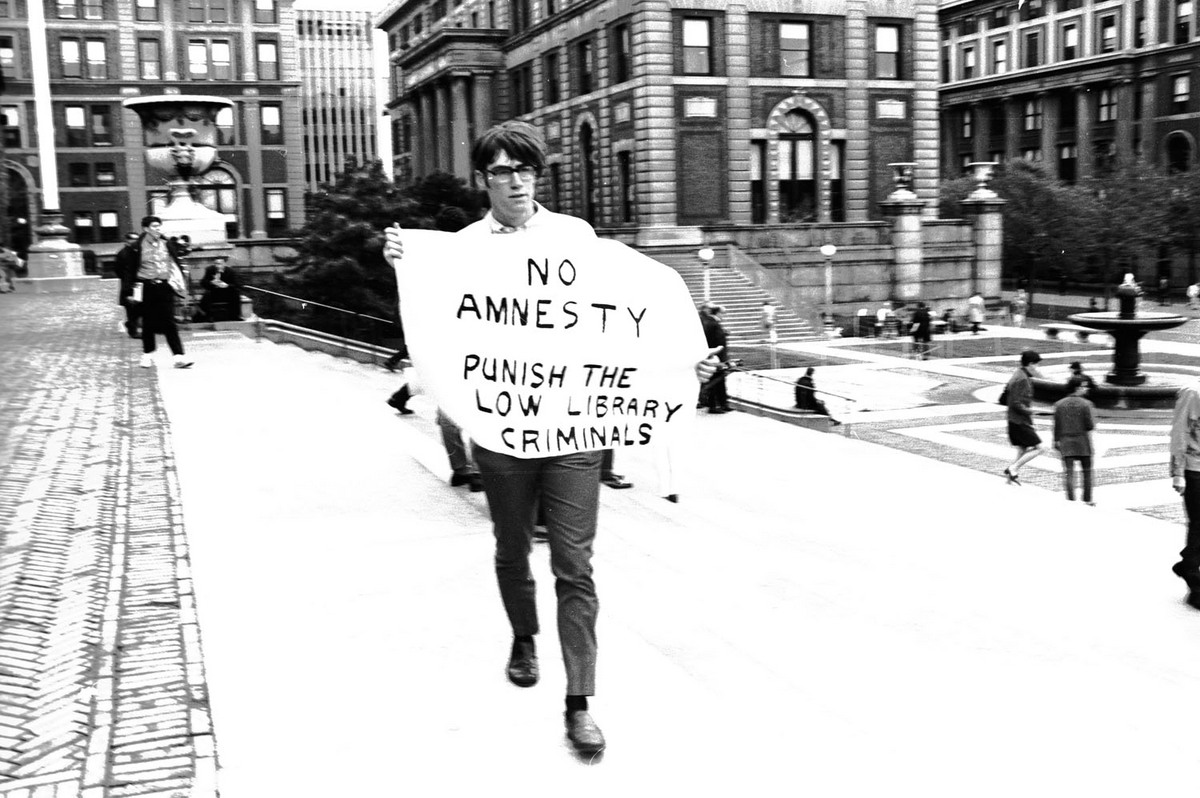
Evening. Majority Coalition reluctantly accepts "bitter pill" resolutions; withdraws its cordon from around Low Library
Anti-SDS student protesting against student occupation of buildings.
TUESDAY, April 30
TUESDAY, April 30
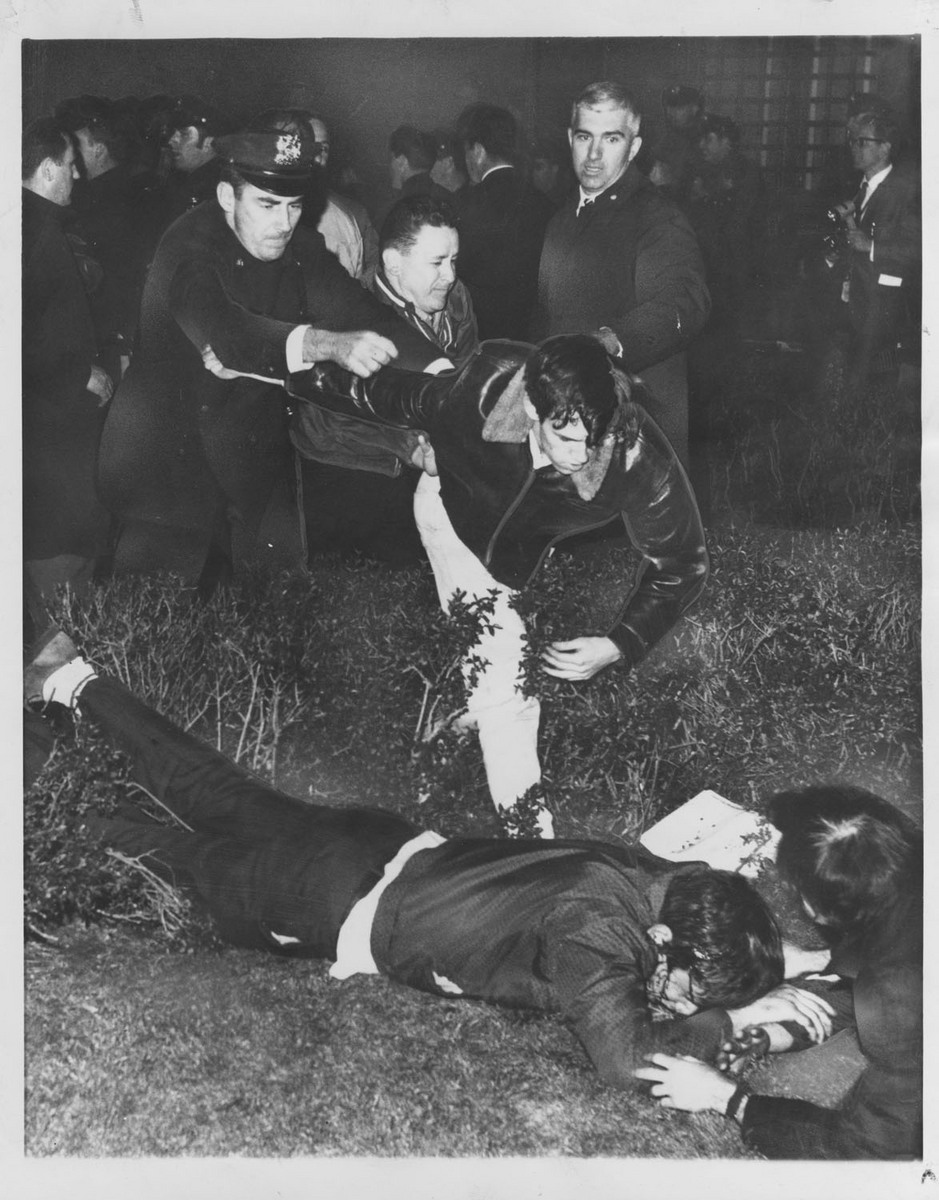
2:30 a.m. - 5:30 a.m. New York City police remove students from occupied buildings and clear campus; 712 arrested, 148 injured
Noon Ad Hoc. Faculty Group meets in McMillin Theatre to discuss a resolution in support of student strike; resolution presented and withdrawn
2:00 p.m. Joint Faculties meet in St. Paul's Chapel, establish Executive Committee of the Faculty
8:00 p.m. Students hold strike meeting in Wollman Auditorium
Police chasing students during the bust, April 30, 1968.
Photo courtesy of Paul Cronin, photographer unknown, 1968
Brochure: "The New Gymnasium"
In 1959, at the urging of trustee Harold McGuire, the University initiated plans to build a gymnasium for Columbia College students that would sit on two acres of public land just inside Morningside Park. The New York Legislature approved Columbia’s gymnasium plans, which included limited community access, in 1960. Initially, this project boasted the support of the administration, the University trustees, College alumni, the local community, and government officials. Unfortunately, fundraising delays held up construction of the building for several years, allowing interested parties ample time to revise their opinions about the project. By the mid-1960s, the University’s allocation of public land for the project provoked increasingly negative feelings among government officials, community groups and Columbia students.
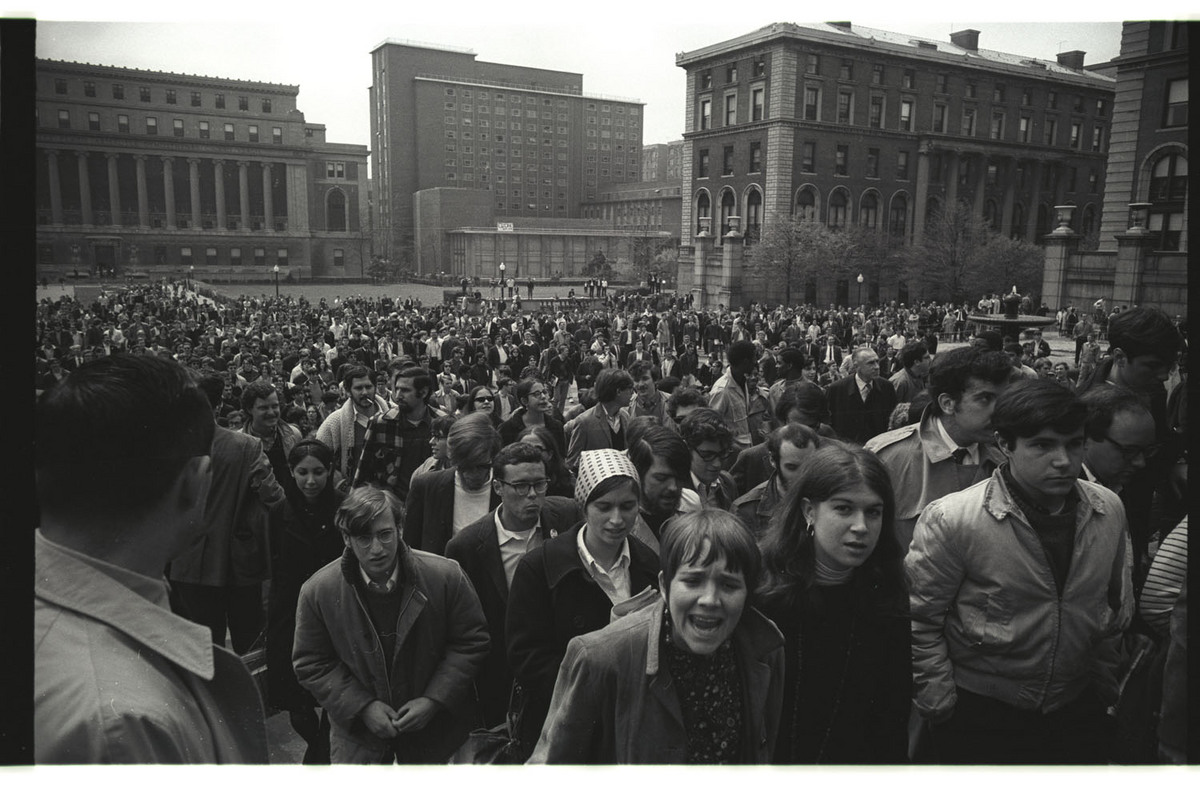
Crowds heading to Low Library
Crowd of people moving towards Low Library from Sun Dial Rally held on April 23, 1968
Original calendar of events
SDS Calendar Vol. II, no. 5. Typewritten calendar of events for the week of April 22, 1968 - before students knew they'd be taking over buildings that week.
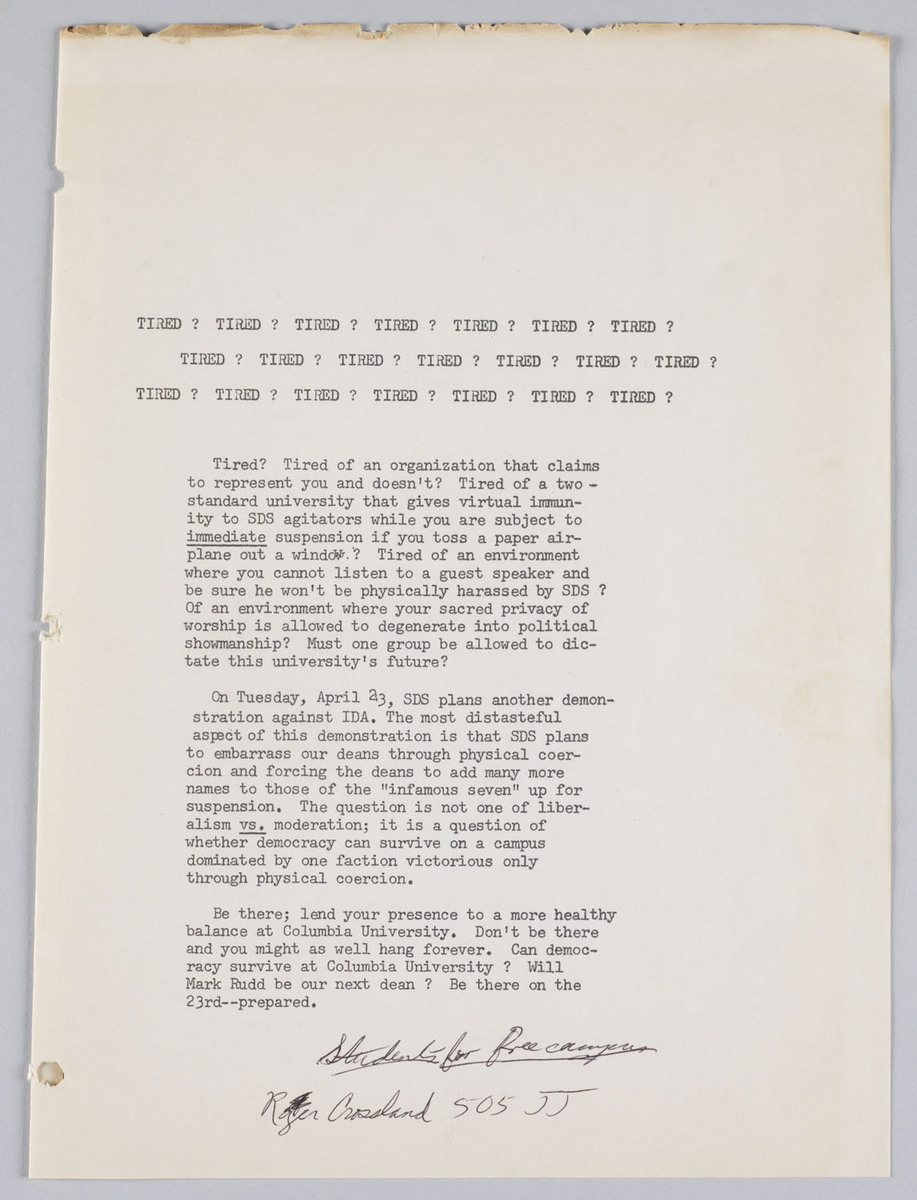
Circular: "Tired? Tired? Tired?"
Students for Free Campus announcing their counter-protest to the SDS sponsored rally at the Sun Dial on Tuesday, April 23, 1968. Typewritten circular.
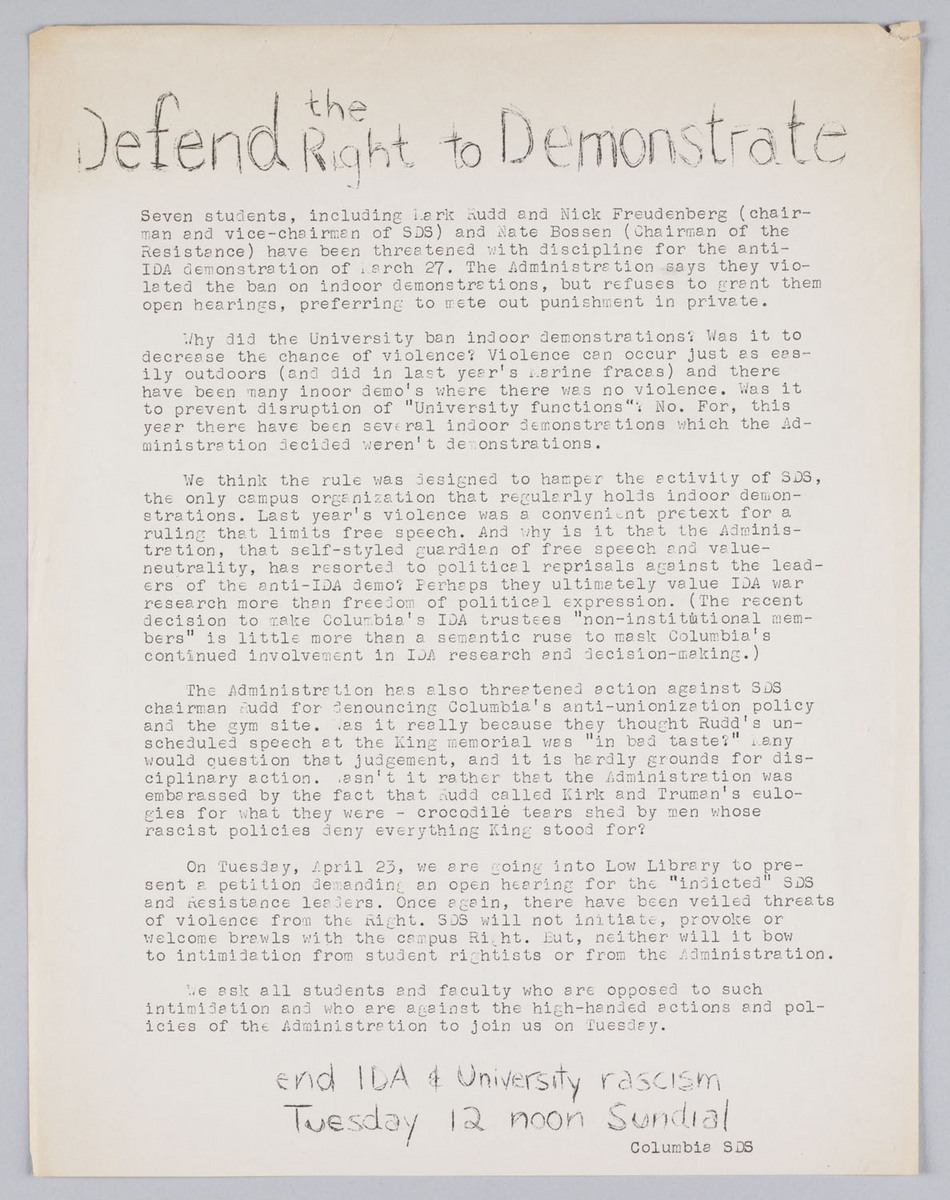
Defend the Right to Demonstrate
This SDS announcement of the April 23 Sun Dial Rally focuses on the fate of the "IDA Six", the right to indoor demonstrations and the right to free speech in response the administration's denouncing of Rudd's interruption at the MLK memorial service. SDS's early agenda did not prioritize termininating the Morningside Park Gymnasium construction.
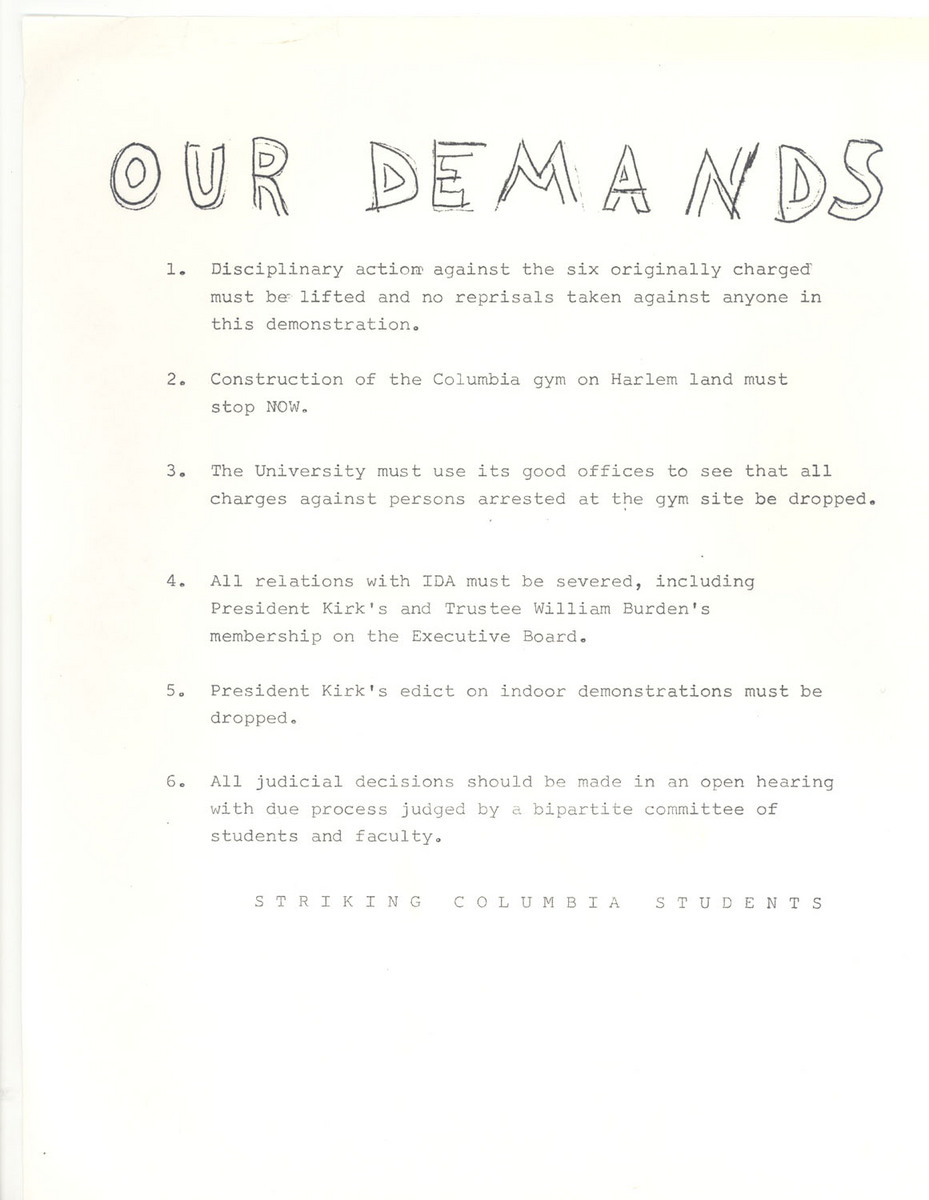
Our Demands
A listing the six demands of the striking students who had occupied Hamilton Hall on the first day of the protests.
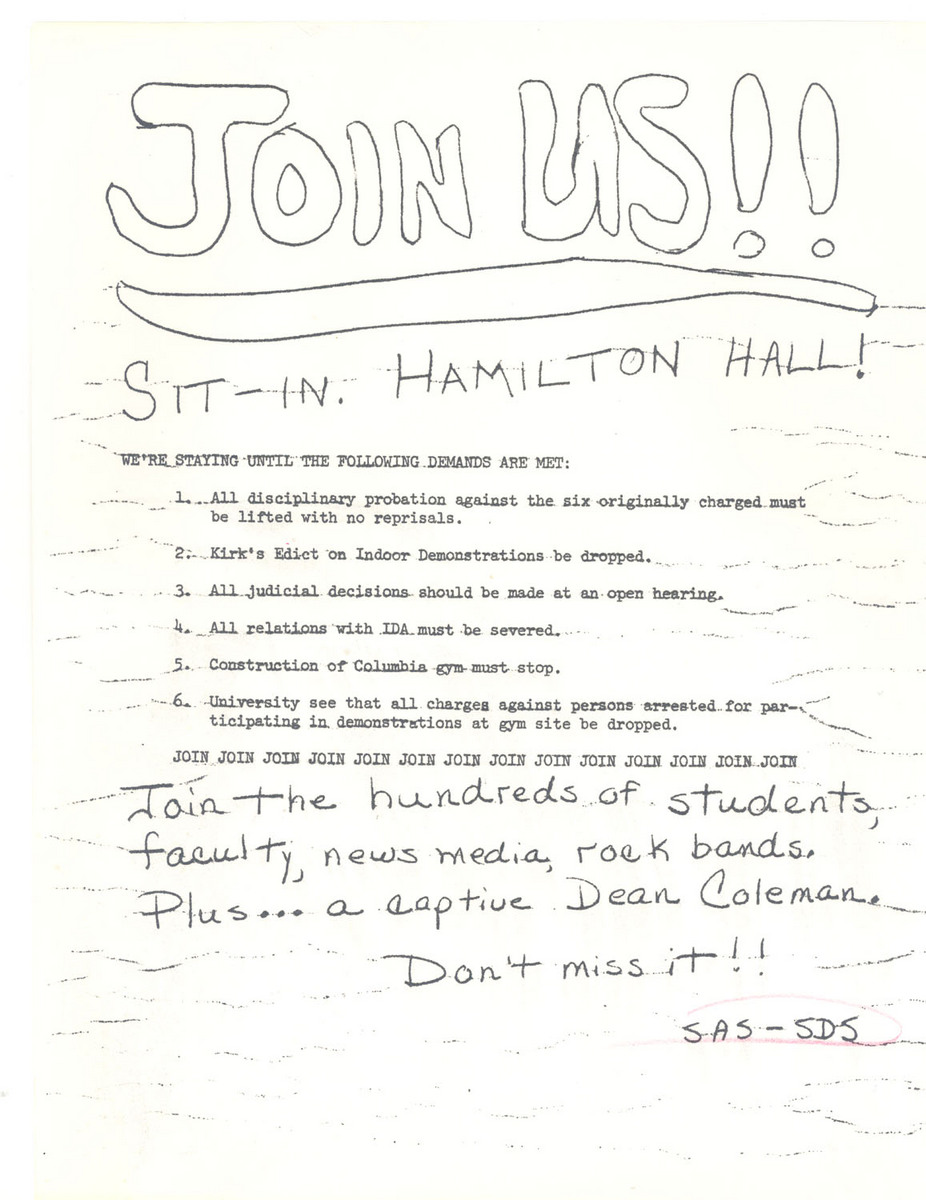
Join Us!
Late in the day on April 23, Black and White students in Hamilton Hall listed their six demands and made reference to "a captive Dean Coleman."
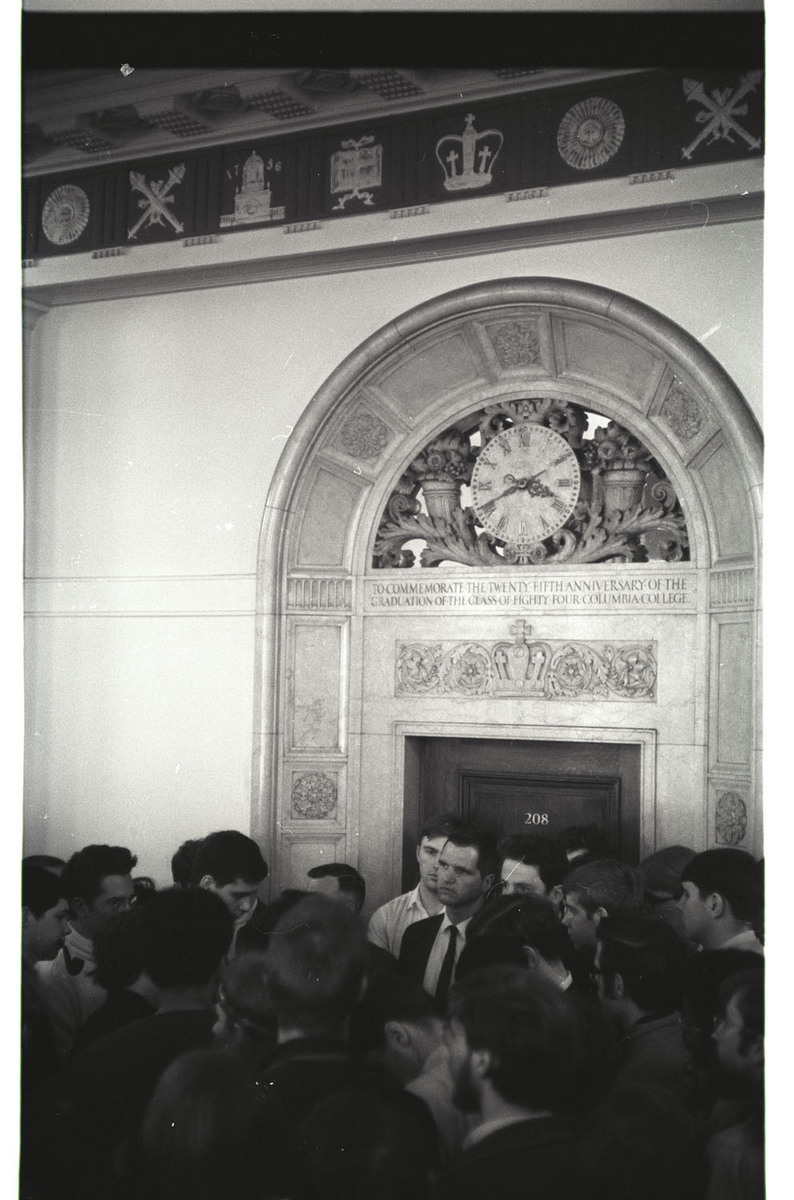
Dean Henry Coleman
Dean Henry Coleman speaking with the protesting students holding him captive in Hamilton Hall, April 23, 1968.
Brochure: "The New Gymnasium"
In 1959, at the urging of trustee Harold McGuire, the University initiated plans to build a gymnasium for Columbia College students that would sit on two acres of public land just inside Morningside Park. The New York Legislature approved Columbia’s gymnasium plans, which included limited community access, in 1960. Initially, this project boasted the support of the administration, the University trustees, College alumni, the local community, and government officials. Unfortunately, fundraising delays held up construction of the building for several years, allowing interested parties ample time to revise their opinions about the project. By the mid-1960s, the University’s allocation of public land for the project provoked increasingly negative feelings among government officials, community groups and Columbia students.
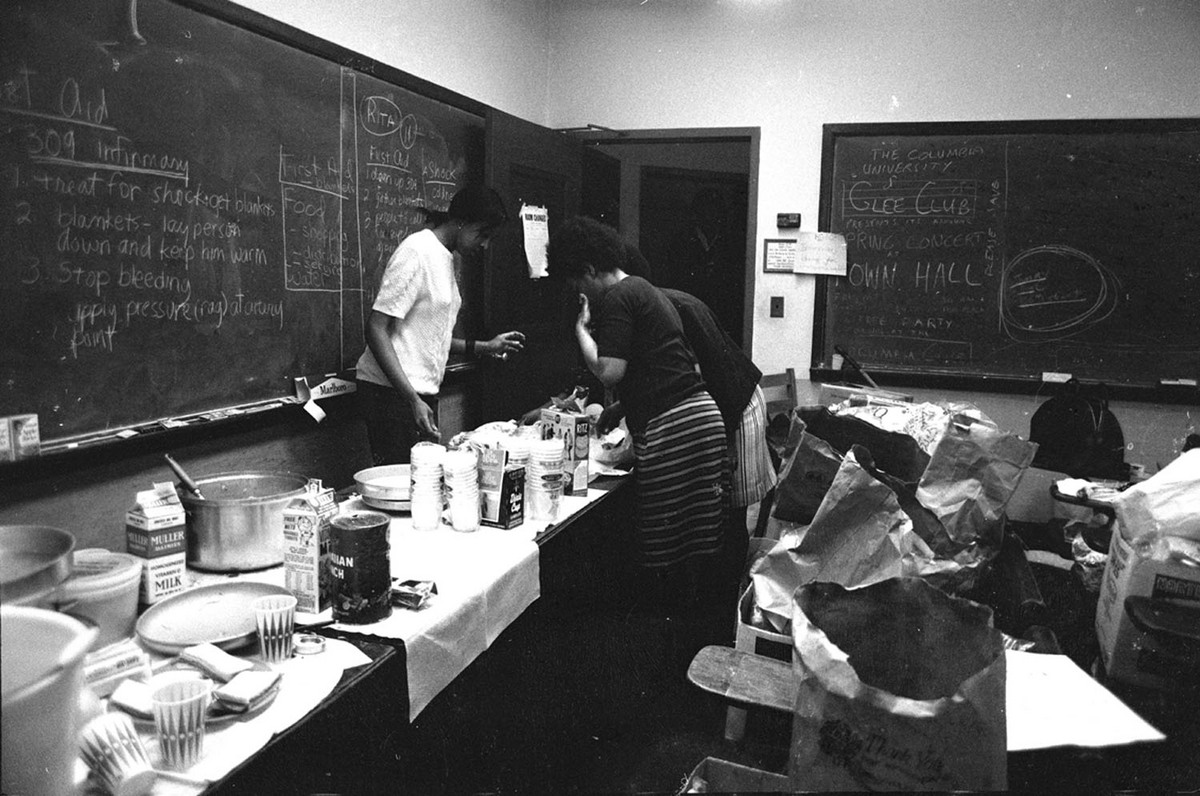
Interior of Hamilton Hall during the occupation.
Interior of Hamilton Hall during the occupation This image may not be reproduced. Please contact the University Archives with any questions.
Food pantry inside Hamilton Hall during the occupation.
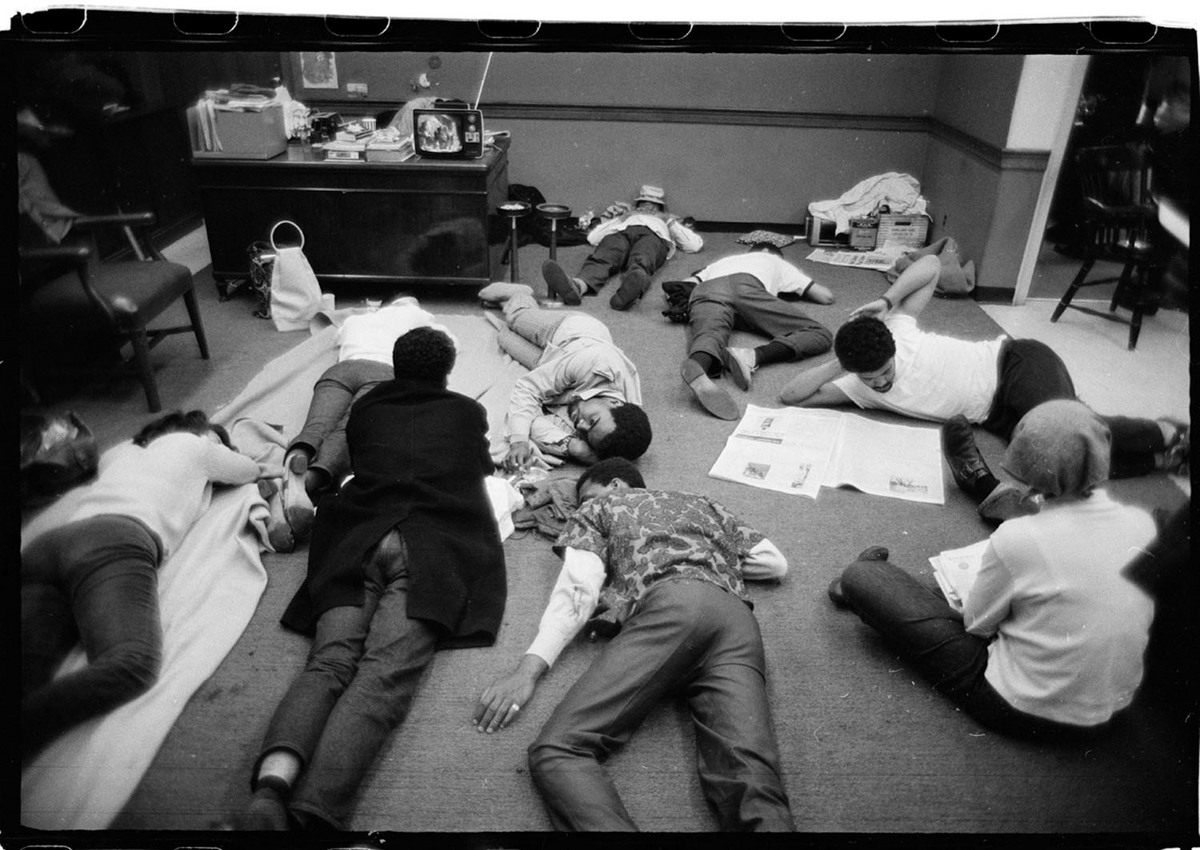
Throughout the last week of April, the black students occupying Hamilton developed an organized, tight-knit, and disciplined community, one that differed sharply from the more boisterous atmosphere of other occupied buildings such as Mathematics. To the administration, however, the black-occupied building appeared a time bomb; Kirk, Truman and the trustees feared that the forcible removal of the SAS students in Hamilton would generate a violent reaction from the nearby Harlem community. This fear helps to explain why the administration waited a week before calling in the police to clear the campus. In fact, when the police entered barricaded Hamilton Hall in the early hours of April 30, the occupying students avoided struggles with the police, calmly marched out the main entrance of the building to the police vans waiting on College Walk.
Students inside occupied Hamilton Hall
This image may not be reproduced. Please contact the University Archives with any questions.
Dean, Alex B. Platt to Columbia University students in Hamilton Hall
The black students occupying Hamilton Hall rejected the administration's early efforts at compromise. This correspondence concerns disciplinary probation for those occupying Hamilton Hall.
H. Rap Brown reading Hamilton Hall statement
Permission to reproduce this image must be obtained from Lee T. Pearcy. Please contact the University Archives for contact information.
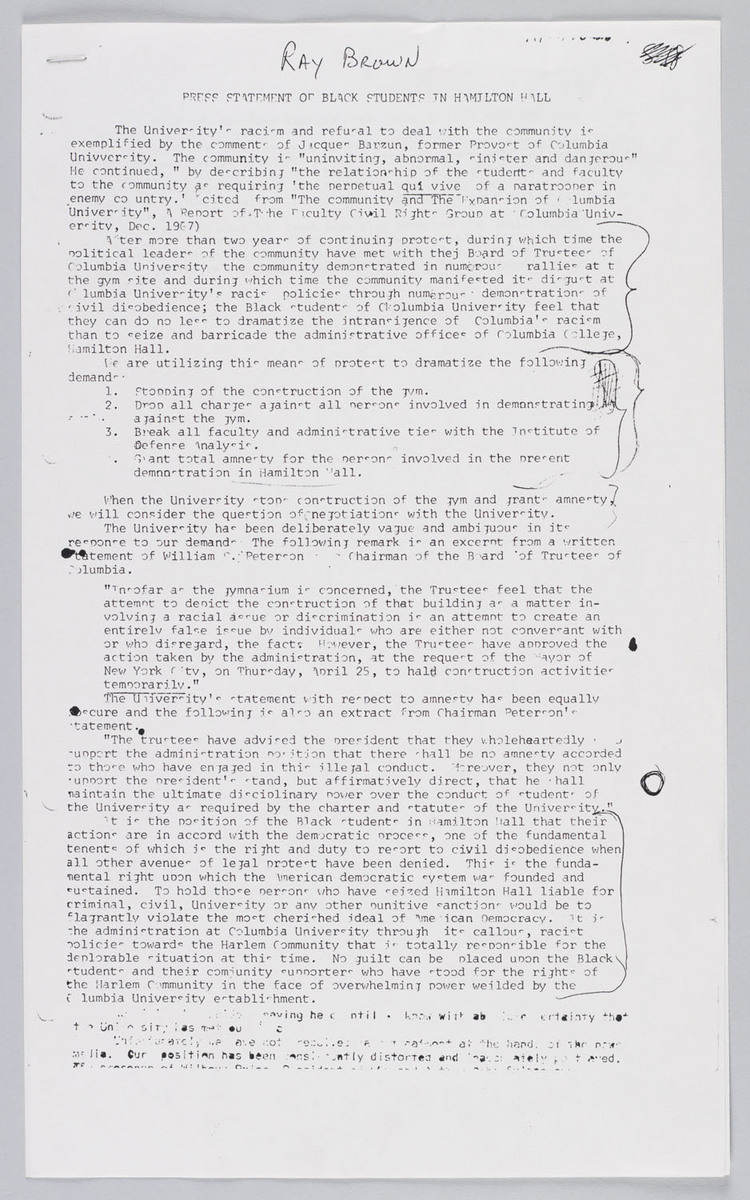
Statement from black students occupying Hamilton Hall
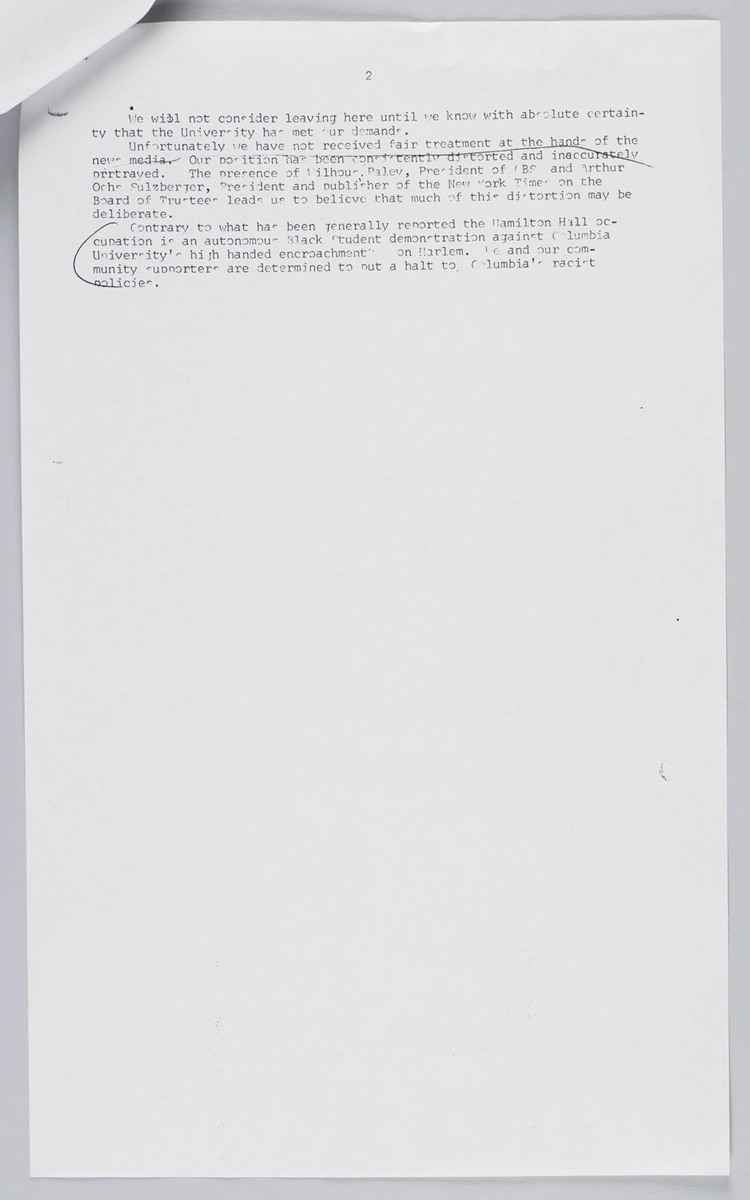
Letter from Rudd and Freudenberg to Kirk
In 1959, Columbia joined the five-year old Institute for Defense Analyses (IDA), and University president Grayson Kirk became Columbia’s representative on the IDA board. IDA served as a forum where leading research universities and government agencies that funded military research could discuss issues of mutual interest. Although IDA did not issue contracts for military research and development, participating members were given de facto priority. Columbia acknowledged its membership in IDA when questioned by SDS in the mid-1960s, but proved less forthcoming about the extent of defense-related secret research conducted at the University. President Kirk refused to consider allowing the faculty to vote on the issue of withdrawal from the IDA when other universities, including Princeton and University of Chicago, were doing just that. In response to growing criticism of Columbia’s involvement in IDA Kirk created the Henkin Committee in January 1968 to investigate the University’s ties to the defense industry.
Related Items
April 2, 1968 letter from President Kirk in response to Rudd and Freudenberg.
Related Items
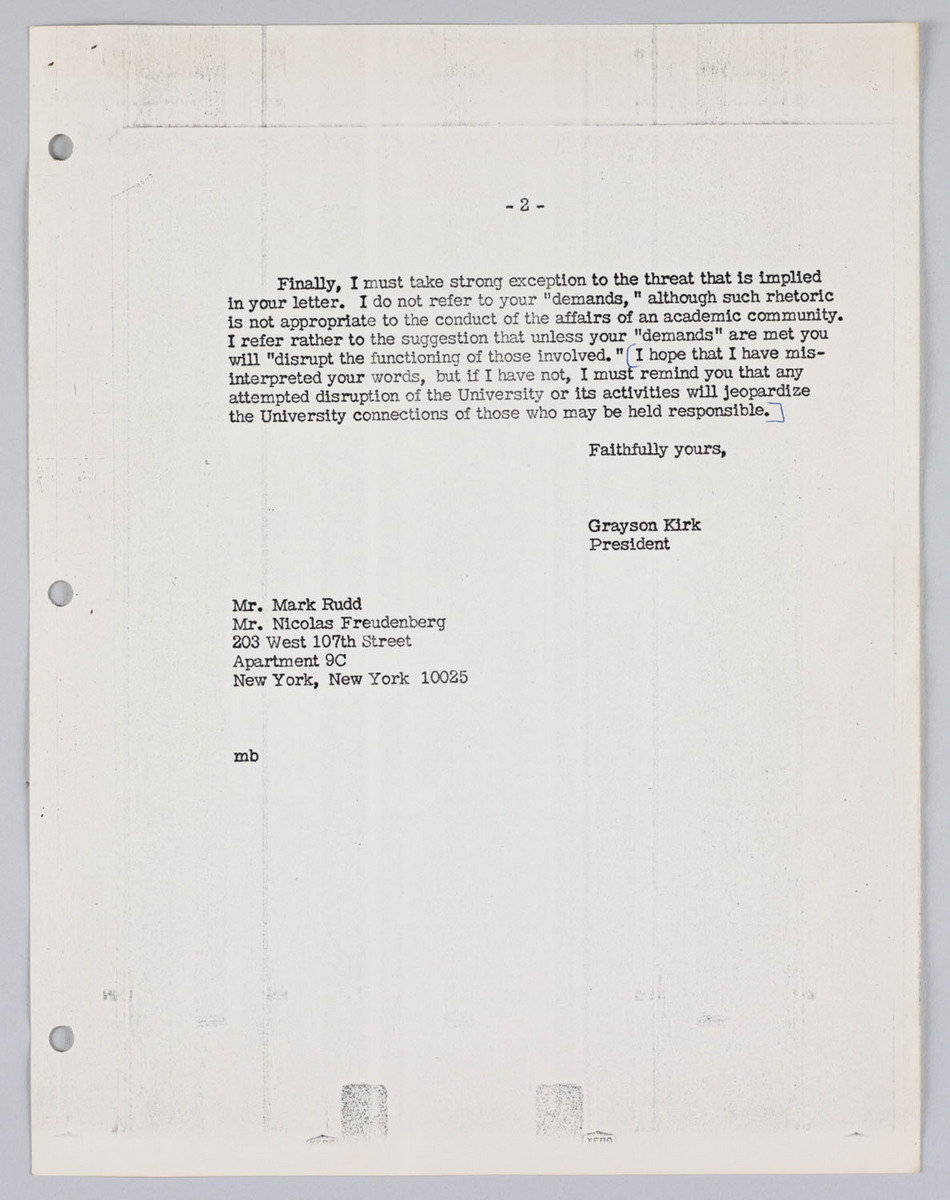
Protestors tearing down protective fencing
Those opposed to the gym were particularly critical of its design. The building provided access to the University community at the top of Morningside Park along its western boundary, while residents of the surrounding Harlem community would enter on the basement level, along the eastern edge of the park, where they would have access to only a small portion of the building. Separate and unequal access to the facilities prompted cries of segregation and racism. The gym, moreover was intended for the exclusive use of Columbia College students, a fact that did not provide graduate and professional students, as well as Barnard and Teachers College students, much reason to support it. Almost immediately after Columbia began construction on the gym in February 1968, demonstrating Columbia students and neighborhood residents descended on the site in protest.
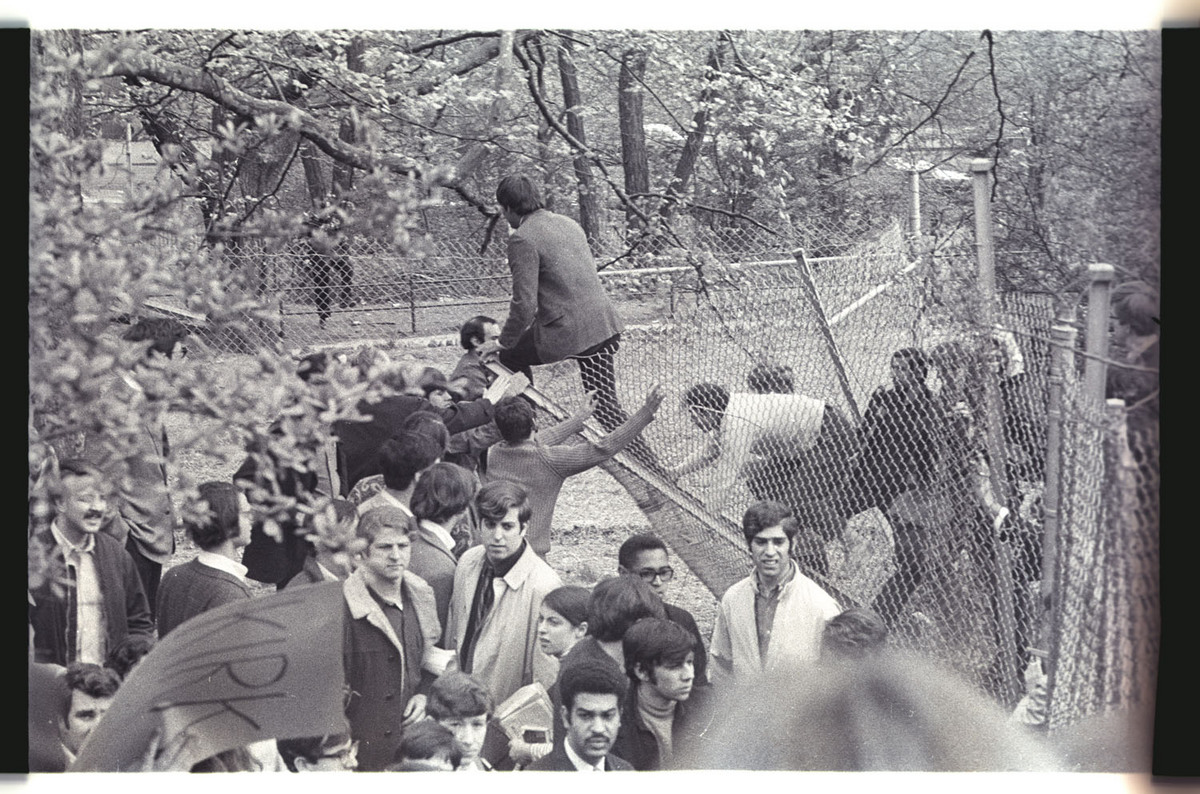
Protestors tearing down protective fencing
Those opposed to the gym were particularly critical of its design. The building provided access to the University community at the top of Morningside Park along its western boundary, while residents of the surrounding Harlem community would enter on the basement level, along the eastern edge of the park, where they would have access to only a small portion of the building. Separate and unequal access to the facilities prompted cries of segregation and racism. The gym, moreover was intended for the exclusive use of Columbia College students, a fact that did not provide graduate and professional students, as well as Barnard and Teachers College students, much reason to support it. Almost immediately after Columbia began construction on the gym in February 1968, demonstrating Columbia students and neighborhood residents descended on the site in protest.
Brochure: "The New Gymnasium"
In 1959, at the urging of trustee Harold McGuire, the University initiated plans to build a gymnasium for Columbia College students that would sit on two acres of public land just inside Morningside Park. The New York Legislature approved Columbia’s gymnasium plans, which included limited community access, in 1960. Initially, this project boasted the support of the administration, the University trustees, College alumni, the local community, and government officials. Unfortunately, fundraising delays held up construction of the building for several years, allowing interested parties ample time to revise their opinions about the project. By the mid-1960s, the University’s allocation of public land for the project provoked increasingly negative feelings among government officials, community groups and Columbia students.
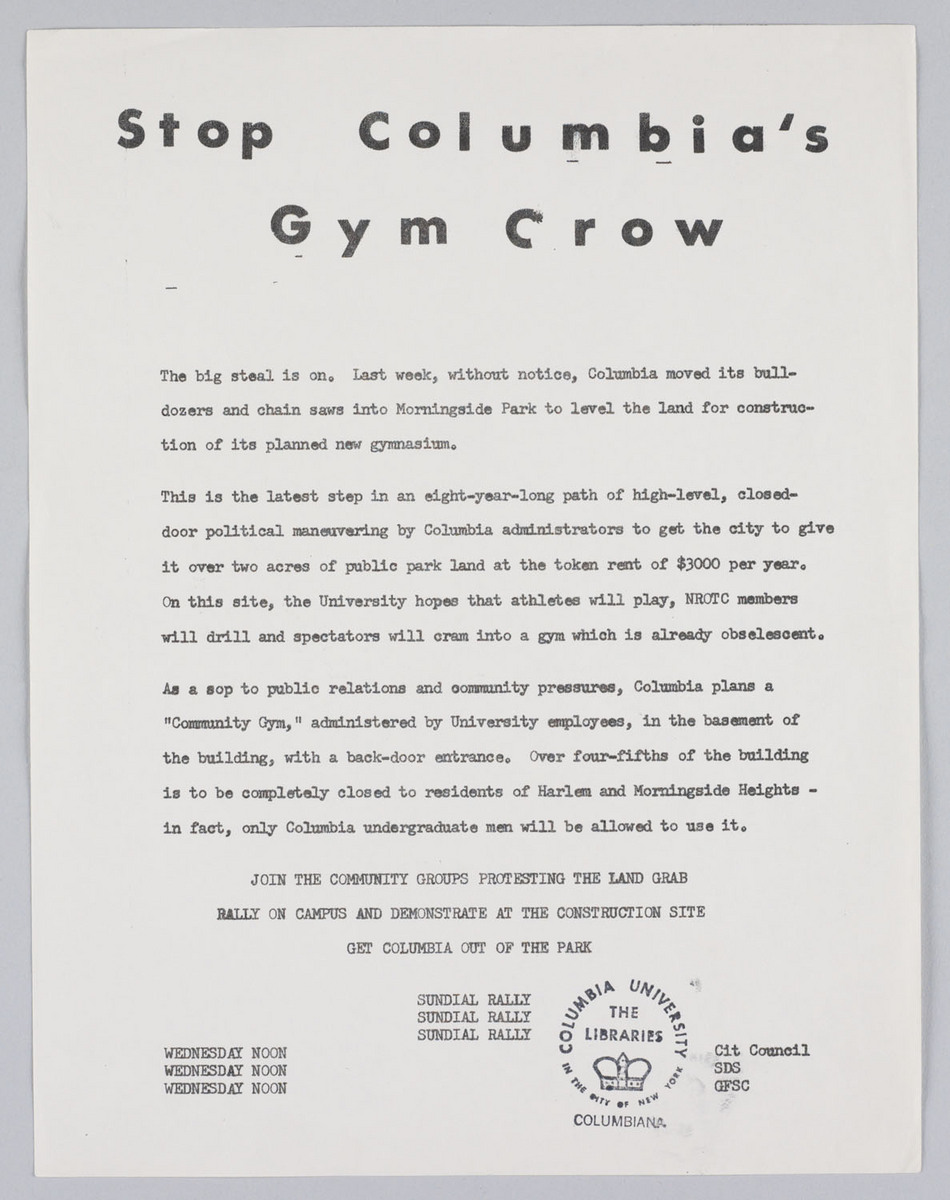
"Stop Columbia's Gym Crow"
The SAS was founded in 1964 by members of Columbia College classes of 1967 and 1968. For several years, the SAS claimed a small membership; most of Columbia’s black students did not join, focusing on their own extra-curricular activities or participating in off-campus political activist groups based in Harlem. On February 18, 1968, the University broke ground on its proposed athletic complex in Morningside Park. The SAS found its galvanizing issue in the gym, arguing that Columbia effectively stole the land from the predominantly black community that had traditionally used Morningside Park. Led by juniors Cicero Wilson and Ray Brown, the organization enlisted the support of the Harlem community and of New York’s leading black activists, and spoke out publicly against the complex, labeling the project “Gym Crow.”
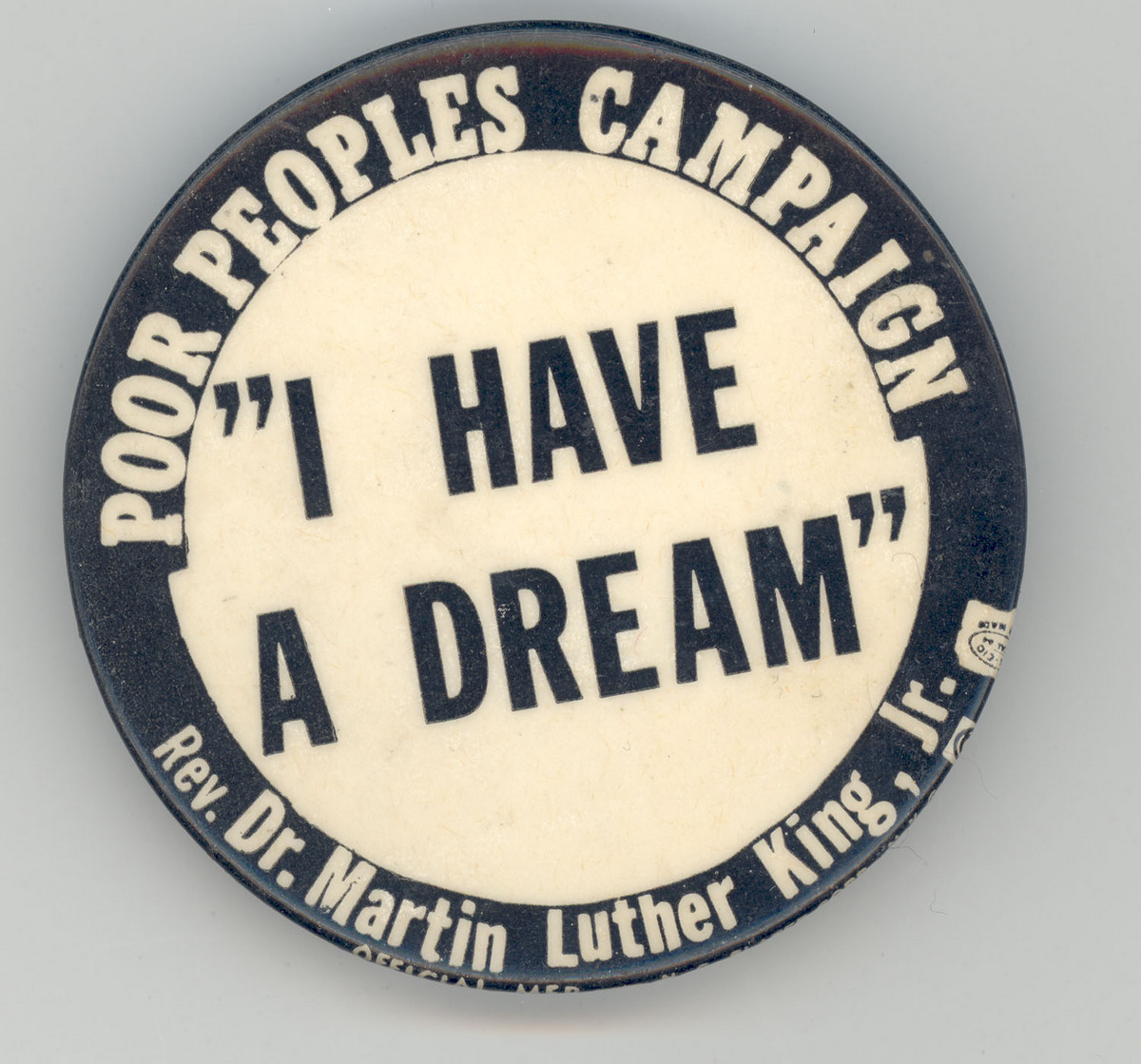
Button: "I Have a Dream," 1968. Courtesy of Frank da Cruz, '71GS, '76E
Among the startling succession of events that rocked the nation in the spring of 1968 - and exacerbated tensions on campus - was the assassination of civil rights leader Rev. Martin Luther King, Jr. on April 4 in Memphis, Tennessee. At Columbia, Chaplain John D. Cannon organized a University memorial service to take place in St. Paul's Chapel on April 9.
Crowds Leaving MLK Memorial Service
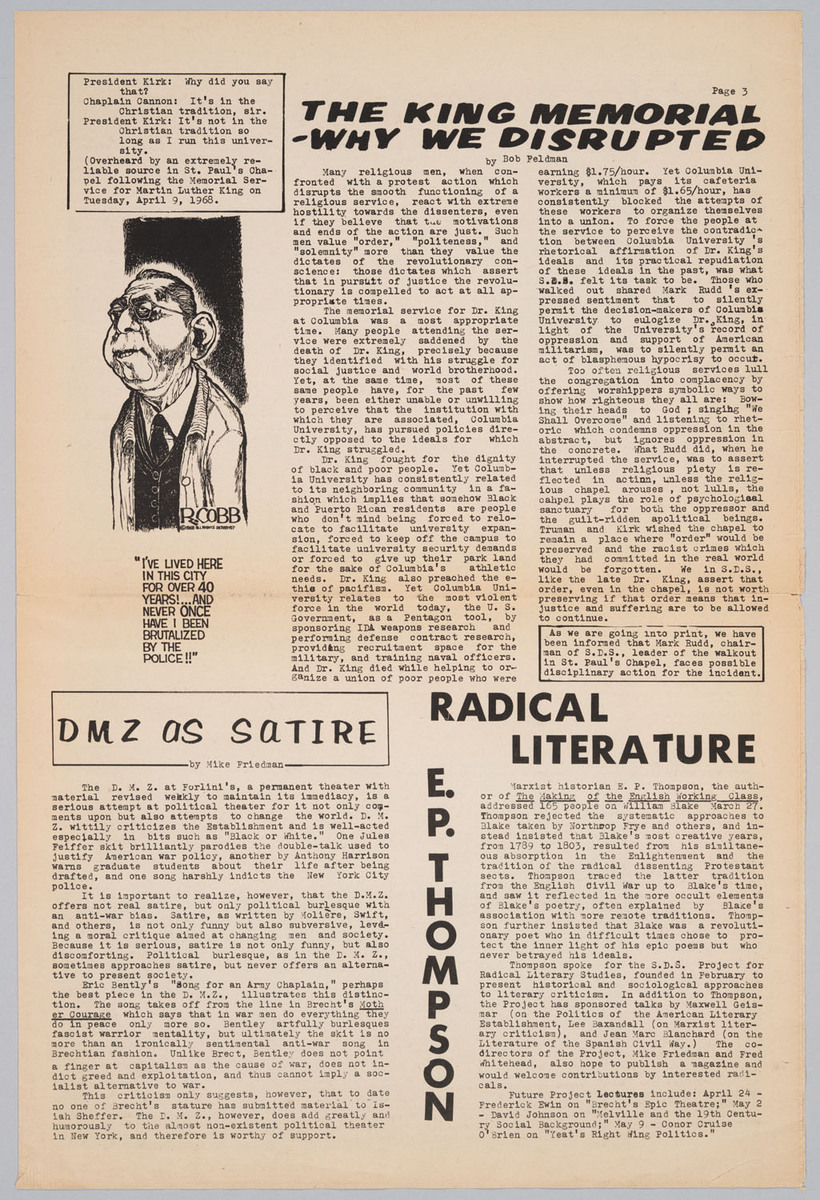
The King Memorial - Why We Disrupted, p. 3
Mark Rudd and other SDS leaders at a Strike Coordinating Committee Press conference
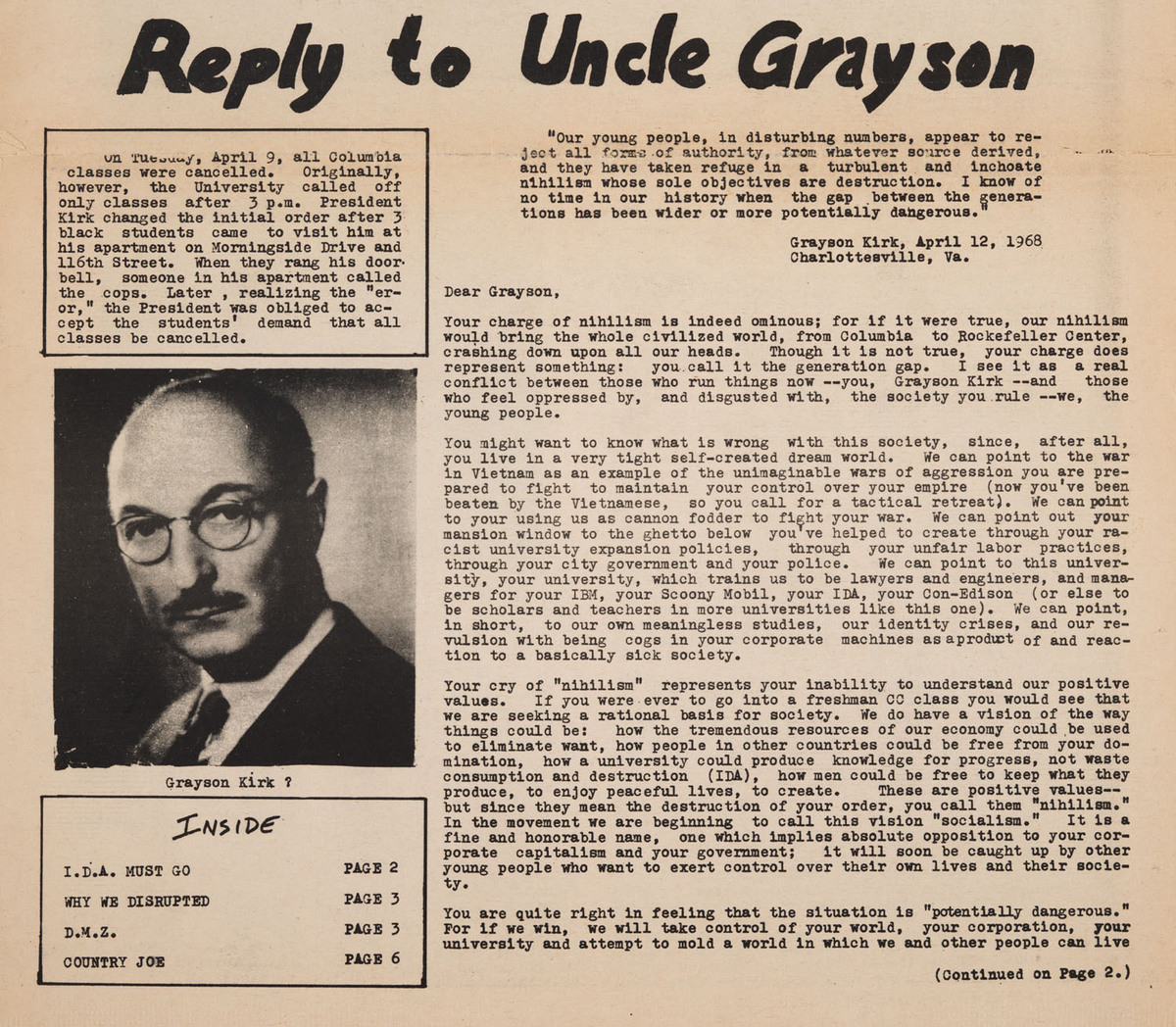
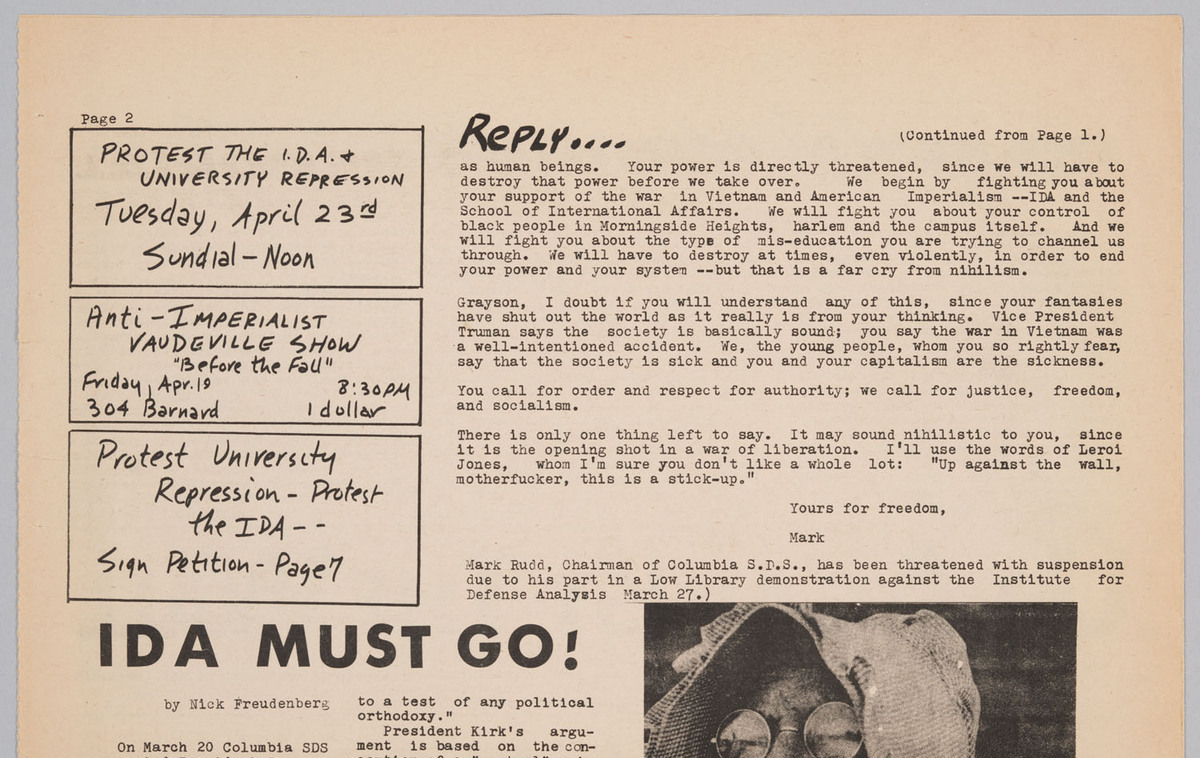
Reply to Uncle Grayson
Columbia students established a small chapter of SDS in 1965. At no time was Columbia’s chapter of SDS any bigger than 50 core members. At first, the organization was led by the “praxis axis,” a group of students focused on education, recruitment, and radical theory rather than large-scale action. When Mark Rudd was elected chairman of SDS in the spring of 1968, however, he proposed and pursued a much more dramatic “action faction” strategy. The March 1968 disciplinary action against the “Low Six,” the continued protest against IDA and open recruitment on campus, and the heated debates ensuing about the Morningside Park gymnasium gave Rudd and SDS a more thorough platform on which to act. The group organized a major rally for April 23, to take place on Low Plaza at the Sun Dial.
SDS button
This image may not be reproduced without the permission of Frank da Cruz. Please contact the University Archives for further information.
Button: "I Have a Dream," 1968. Courtesy of Frank da Cruz, '71GS, '76E
Among the startling succession of events that rocked the nation in the spring of 1968 - and exacerbated tensions on campus - was the assassination of civil rights leader Rev. Martin Luther King, Jr. on April 4 in Memphis, Tennessee. At Columbia, Chaplain John D. Cannon organized a University memorial service to take place in St. Paul's Chapel on April 9.
Columbia Daily Spectator, April 30
Students being chased by police
Permission to reproduce this image must be obtained from Paul Cronin. Please contact the University Archives for contact information.
After the police bust
"Kirk Bans Pickets in CU Buildings: September 25, 1967 "
On April 21, 1967 the first student-to-student clash erupted when 500 students favoring the policy of open recruitment on campus confronted 800 anti-recruitment demonstrators. Student disruption of military recruiters prompted University President Grayson Kirk to issue a ban against picketing and demonstrations inside all University buildings as of September 1967.
Related Items
1968: Columbia in Crisis
Columbia University Libraries
The occupation of five buildings in April 1968 marked a sea change in the relationships among Columbia University administration, its faculty, its student body, and its neighbors. Featuring documents, photographs, and audio from the University Archives, 1968: Columbia in Crisis examines the the causes, actions, and aftermath of a protest that captivated the campus, the nation, and the world. This online exhibition is based upon a physical exhibition of the same name which was on display in the Rare Book and Manuscript Library from March 17 to August 1, 2008. Unless otherwise noted, all images and documents are from collections found in the Columbia University Archives.
Exhibit Curator Jocelyn Wilk
Causes: Recruiting on Campus and Demonstration Restrictions
Student demonstrations at Columbia University date back to its earliest years but intensified in the late 1960s. In February 1967, eighteen members of the Students for a Democratic Society (SDS) staged Columbia’s first sit-in at Dodge Hall, protesting CIA recruitment on campus. Other demonstrations opposed the University's submission of student class rankings to Selective Service Boards, military recruitment on campus, and involvement in the Institute for Defense Analyses (IDA). On April 21, 1967, the first student-to-student clash erupted when 500 students supporting open recruitment on campus confronted 800 anti-recruitment demonstrators. This disruption led University President Grayson Kirk to ban picketing and demonstrations inside all University buildings starting in September 1967. These actions marked a significant period of activism and conflict on campus, reflecting broader societal tensions during the era.
Columbia Daily Spectator article: "Kirk Bans Pickets in CU Buildings," September 25, 1967
Letter from Associate Dean, Alex B. Platt to Columbia College student, Ted Gold, April 5, 1968.
Circular: "Live Music, ROTC, Food, ROTC, Theater, ROTC"
Timeline of Events
A timeline of the events of April 23-30, 1968.
Original calendar of events proposed by SDS for the week of April 22 to April 27, 1968.
Students occupying President Kirk's office
Grayson Kirk and David Truman at press conference in the Faculty Room of Low Memorial Library, April 25, 1968
H. Rap Brown reading Hamilton Hall statement, Friday, April 26, 1968
Faculty members talking to students occupying Low Library.
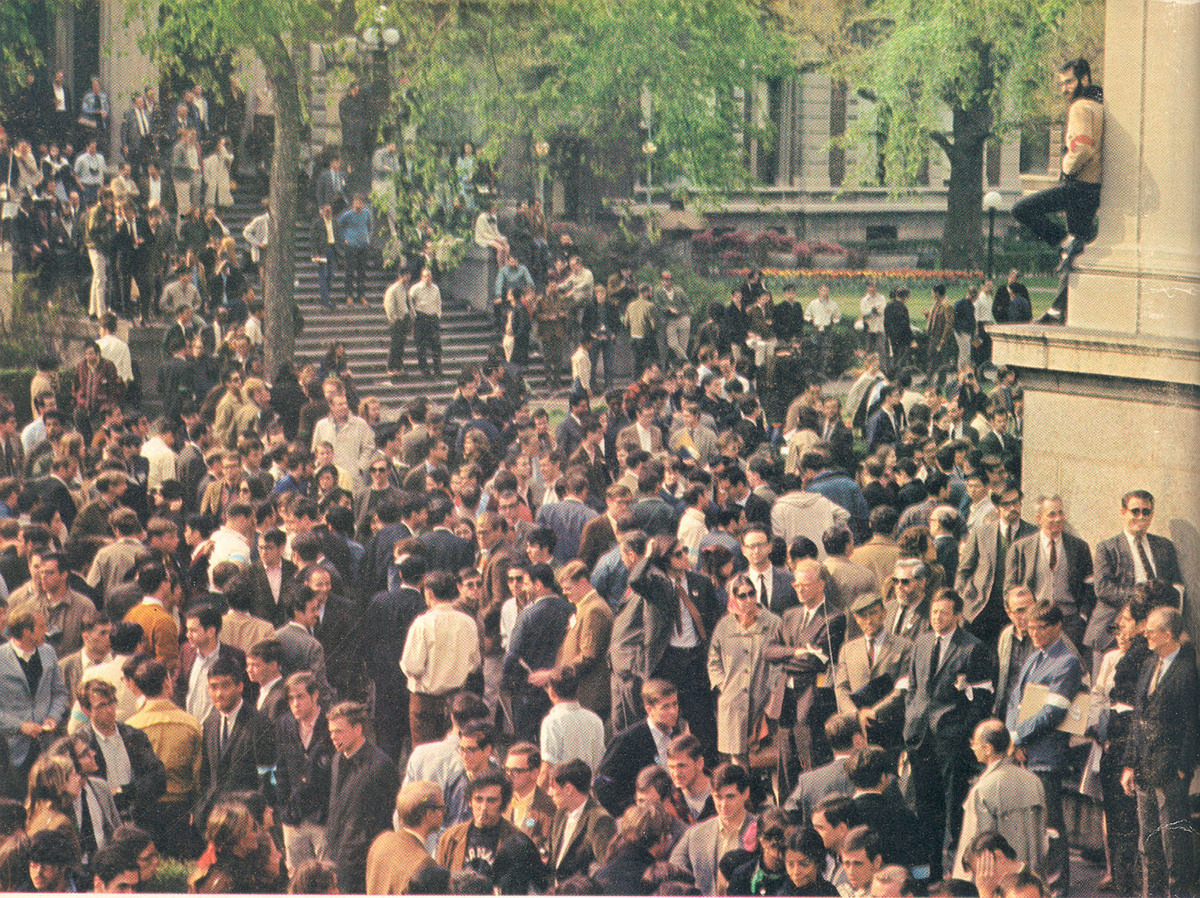
Color image of crowds outside of occupied Low Library originally printed on the back cover of "Six Weeks That Shook Morningside" published by Columbia College Today (Volume 15, Number 3,1968 Spring)
Anti-SDS student protesting against student occupation of buildings.
Police chasing students during the bust, April 30, 1968.
The First Day - April 23, 1968
SAS had always operated separately from SDS, but the two organizations came together on the issue of the gymnasium. Meeting on April 22, SAS president Cicero Wilson and SDS chairman Mark Rudd endorsed the Sun Dial Rally planned for the next day. At noon on April 23, 300 people gathered at the Sun Dial. Both Wilson and Rudd addressed the large crowd that had assembled on Low Plaza. The crowd attempted to enter Low Library to present President Kirk with a list of demands, but found the building locked and the steps in front of the building occupied by 200 anti-demonstrators. The protesters then proceeded to the gym construction site, where they tore down the area’s protective fencing; police at the scene arrested Fred Wilson (CC 1969) in a scuffle. At Rudd’s urging, the other protestors returned to campus and then made their way into Hamilton Hall, where they were joined by anti-protesters and by students attending classes. During their occupation, protesters restrained acting Dean Henry Coleman from leaving his office. President Kirk, off campus for the afternoon, proposed calling in the police, but Provost David Truman and Dean Coleman advised against this for fear of a violent confrontation. Meanwhile, SAS and SDS groups inside Hamilton formed two separate steering committees to consider further action. Several hundred students and three deans spent the night inside the building. Members of the College faculty called for a meeting of the faculty for the next afternoon.
Brochure: "The New Gymnasium" Cross section of proposed gymansium that highlights the inequality between the Columbia and community spaces.
Crowds heading to Low Library from the SAS/SDS Sun Dial Rally, April 23, 1968 Photo courtesy of Gerald S. Adler, photographer, 1968
Original calendar of events
Students for Free Campus announcing their counter-protest to the SDS sponsored rally
Circular: "Defend the Right to Demonstrate"
The six demands of the striking students
Circular: "Join Us!"
Dean Henry Coleman
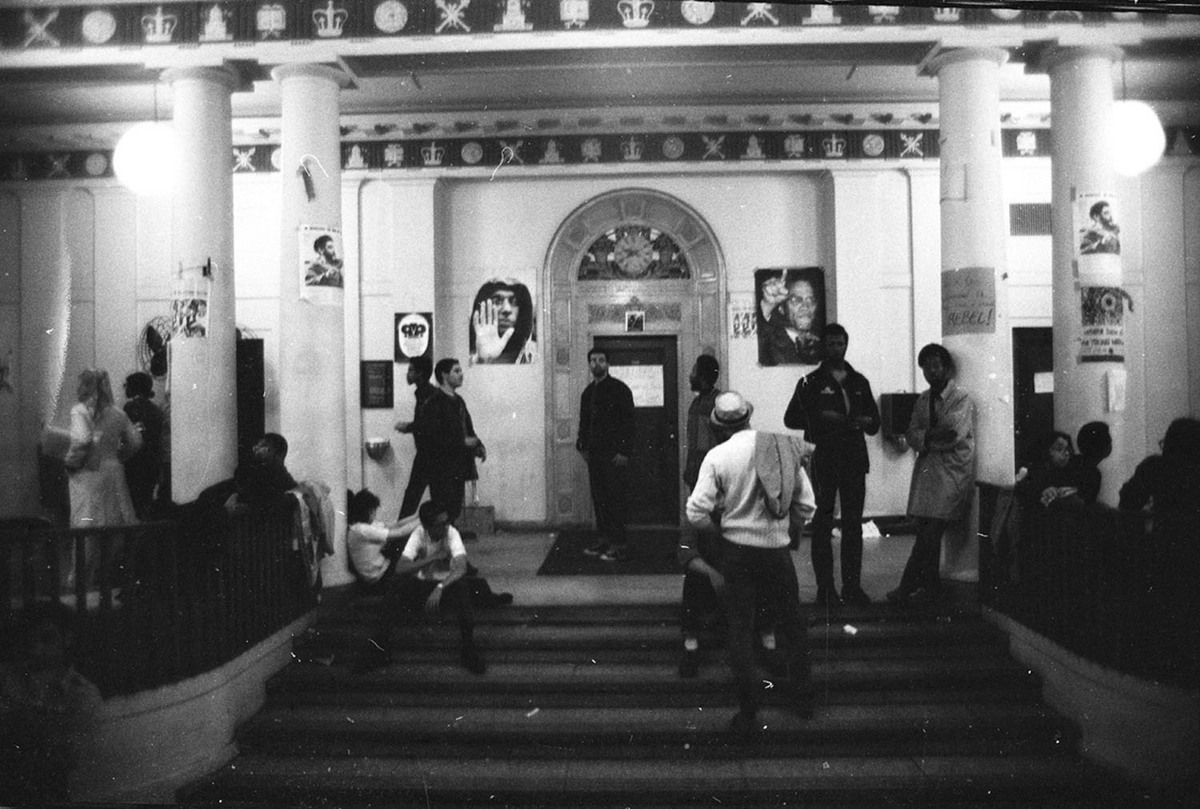
SAS Occupation of Hamilton Hall
Hamilton Hall remained racially integrated for only a short time after its April 23 occupation. By early morning on April 24, the eighty-six black students “evicted” the white students inside Hamilton Hall. SAS leaders later explained that the spontaneous, participatory, and less-defined politics of SDS-led white students interfered with the specific goals that SAS was advancing in it is occupation of Hamilton Hall (renamed by its occupants “Malcolm X Liberation College”).
Brochure: "The New Gymnasium" Cross section of proposed gymansium that highlights the inequality between the Columbia and community spaces.
Interior of Hamilton Hall during the occupation. Courtesy of St. Clair Bourne, photographer, 1968
Food pantry inside Hamilton Hall during the occupation. Courtesy of St. Clair Bourne, photographer, 1968
Students inside Hamilton Hall during the occupation
Letter from Associate Dean, Alex B. Platt to Columbia University students in Hamilton Hall, April 24, 1968.
H. Rap Brown reading Hamilton Hall statement, Friday, April 26, 1968.
Statement from black students occupying Hamilton Hall that was read by H. Rap Brown on Friday, April 26, 1968
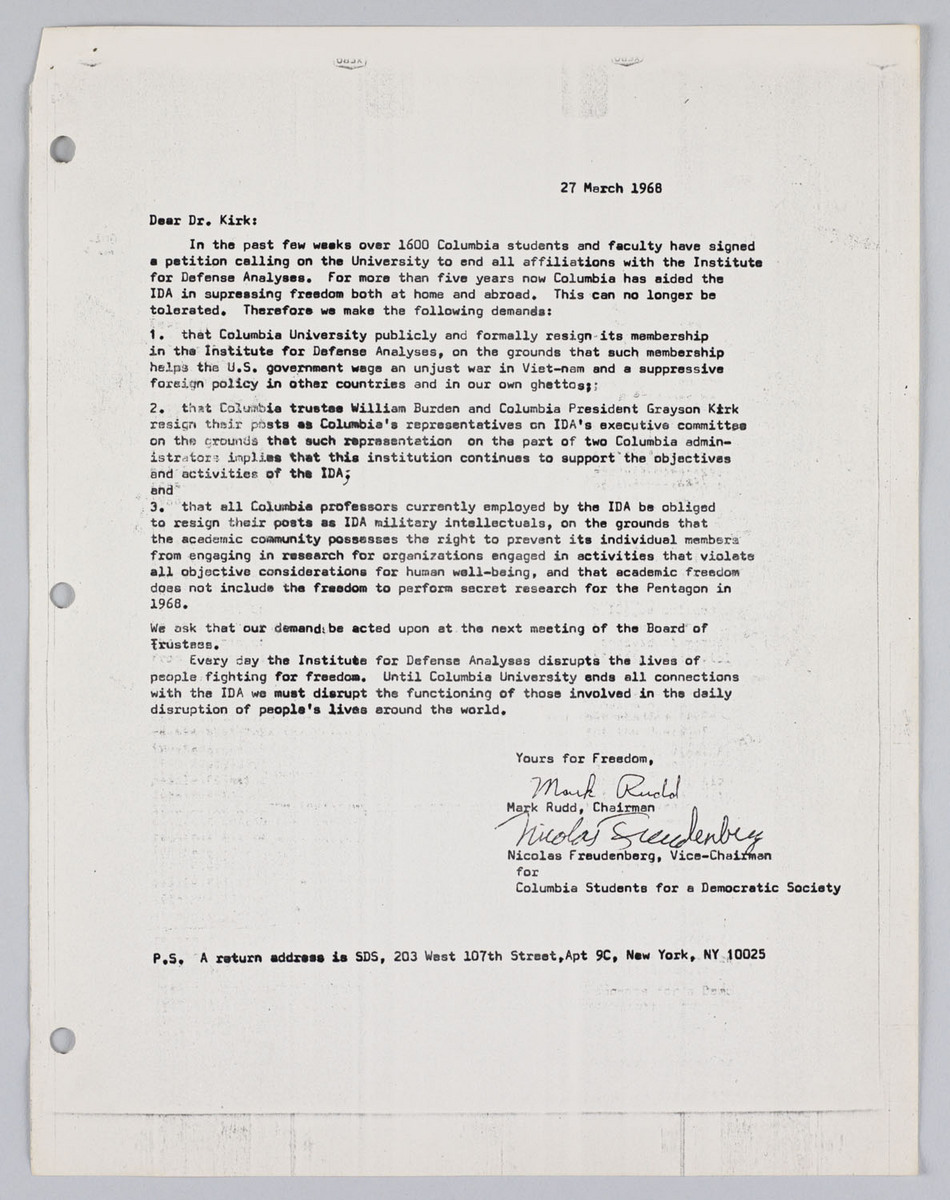
Causes: Institute for Defence Analysis
In 1959, Columbia joined the five-year old Institute for Defense Analyses (IDA), and University president Grayson Kirk became Columbia’s representative on the IDA board. IDA served as a forum where leading research universities and government agencies that funded military research could discuss issues of mutual interest. Although IDA did not issue contracts for military research and development, participating members were given de facto priority. Columbia acknowledged its membership in IDA when questioned by SDS in the mid-1960s, but proved less forthcoming about the extent of defense-related secret research conducted at the University. President Kirk refused to consider allowing the faculty to vote on the issue of withdrawal from the IDA when other universities, including Princeton and University of Chicago, were doing just that. In response to growing criticism of Columbia’s involvement in IDA Kirk created the Henkin Committee in January 1968 to investigate the University’s ties to the defense industry.
etter from Mark Rudd and Nicholas Freudenberg to President Grayson Kirk, March 27, 1968. The letter calls on Kirk to end all affiliations between Columbia and the IDA.
April 2, 1968 letter from President Kirk written in response to the one he received from Mark Rudd and Nicholas Freudenberg.
Protestors tearing down protective fencing at the gymnasium construction site in Morningside Park, April 23, 1968. Courtesy of Steve Ditlea '69C, photographer, 1968
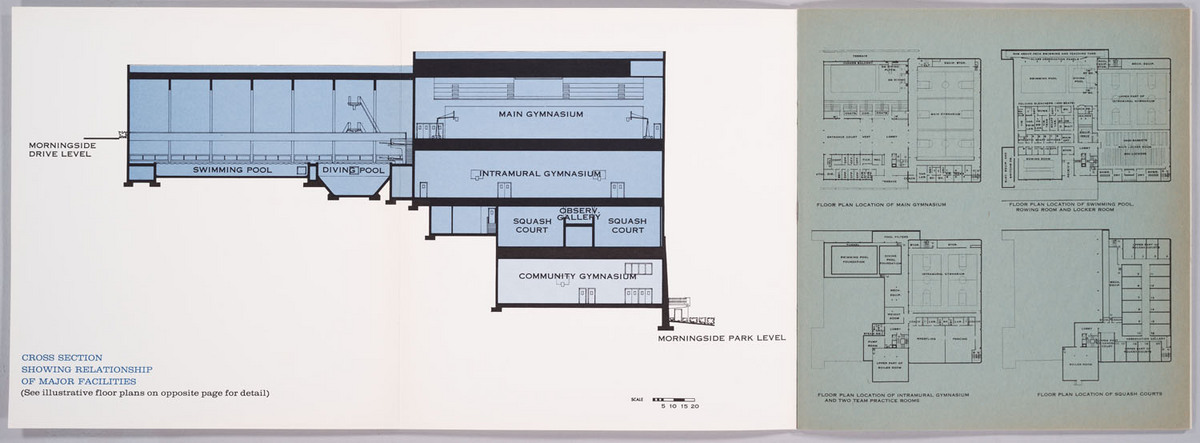
Causes: Morningside Park Gymnasium
In 1959, at the urging of trustee Harold McGuire, the University initiated plans to build a gymnasium for Columbia College students that would sit on two acres of public land just inside Morningside Park. The New York Legislature approved Columbia’s gymnasium plans, which included limited community access, in 1960. Initially, this project boasted the support of the administration, the University trustees, College alumni, the local community, and government officials. Unfortunately, fundraising delays held up construction of the building for several years, allowing interested parties ample time to revise their opinions about the project. By the mid-1960s, the University’s allocation of public land for the project provoked increasingly negative feelings among government officials, community groups and Columbia students.
Protestors tearing down protective fencing at the gymnasium construction site in Morningside Park, April 23, 1968. Courtesy of Steve Ditlea '69C, photographer, 1968
Brochure: "The New Gymnasium" Cross section of proposed gymansium that highlights the inequality between the Columbia and community spaces.
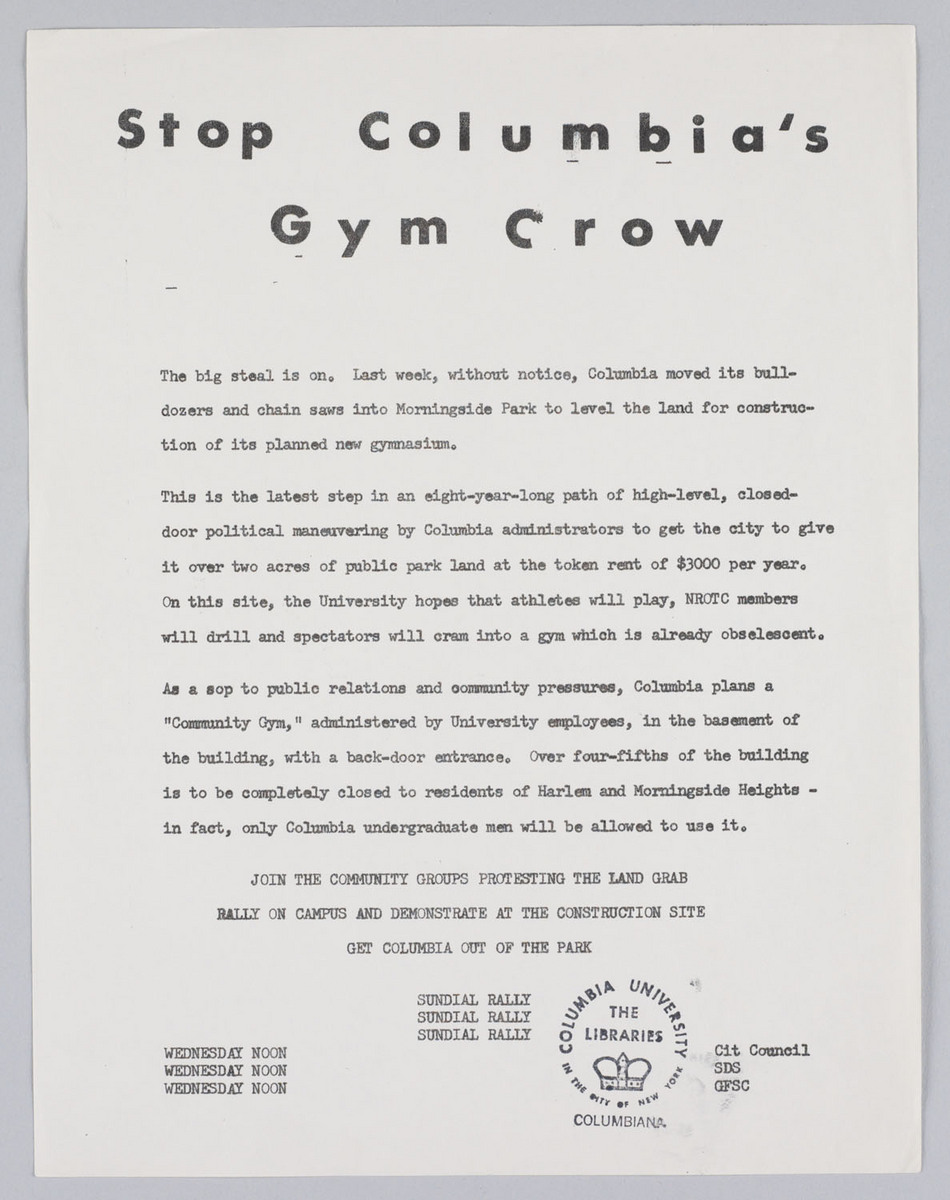
Causes: Society of Afro-American Students (SAS)
The SAS was founded in 1964 by members of Columbia College classes of 1967 and 1968. For several years, the SAS claimed a small membership; most of Columbia’s black students did not join, focusing on their own extra-curricular activities or participating in off-campus political activist groups based in Harlem. On February 18, 1968, the University broke ground on its proposed athletic complex in Morningside Park. The SAS found its galvanizing issue in the gym, arguing that Columbia effectively stole the land from the predominantly black community that had traditionally used Morningside Park. Led by juniors Cicero Wilson and Ray Brown, the organization enlisted the support of the Harlem community and of New York’s leading black activists, and spoke out publicly against the complex, labeling the project “Gym Crow.”
Circular: "Stop Columbia's Gym Crow"
Causes: Martin Luther King, Jr. Memorial Service
Among the startling succession of events that rocked the nation in the spring of 1968 - and exacerbated tensions on campus - was the assassination of civil rights leader Rev. Martin Luther King, Jr. on April 4 in Memphis, Tennessee. At Columbia, Chaplain John D. Cannon organized a University memorial service to take place in St. Paul's Chapel on April 9.
Among the startling succession of events that rocked the nation in the spring of 1968 - and exacerbated tensions on campus - was the assassination of civil rights leader Rev. Martin Luther King, Jr. on April 4 in Memphis, Tennessee.
Crowds leaving St. Paul's Chapel after the the Martin Luther King, Jr. memorial service, April 9, 1968.
"The King Memorial - Why We Disrupted" from Up Against the Wall, SDS's newsletter, April 22, 1968 (p. 3)
Causes: Students for a Democratic Society (SDS)
Students for a Democratic Society (SDS) was established at the University of Michigan in 1962. Undergraduate Tom Hayden’s “Port Huron Statement,” which served as a mission statement for the organization, expressed his generation’s disillusionment with the Liberal Establishment and the Old Left, the military industrial complex, and what it saw as an apathetic, consumption-driven mainstream American culture.
Mark Rudd and other SDS leaders at a Strike Coordinating Committee Press conference held on Friday, April 26, 1968
Facsimile of the infamous letter from Mark Rudd to President Grayson Kirk entitled "Reply to Uncle Grayson" re-printed in Up Against the Wall, April 22, 1968 (p.1-2). Rudd ends the letter defiantly by writing, in the words of LeRoi Jones, "Up against the
Columbia SDS button, 1968
The Bust
THE BUST: Tuesday April 30, 1968 2:00 a.m: police, under the operational control of Chief Inspector Sanford Garelick, peacefully removed black students from Hamilton Hall, after entering the building through underground tunnels. Alerted to the imminent police action, the students chose not to resist. The police made 86 arrests. 2:15 a.m.: police entered Low Library through tunnels, removing occupying students. Again, police met no violent resistance, and made 93 arrests. 2:30 a.m.: police entered Avery Hall through the main doors to clear the building of occupying students. The police met moderate resistance, and some students received injuries. The police made 42 arrests. 2:45 a.m.: police entered Fayerweather Hall through the main doors to clear the building of occupying students. There they met scattered resistance inside and outside the building. A number of minior injuries occurred. The police made 268 arrests. 3:00 a.m.: police entered Mathematics Hall, where they faced the strongest student resistance. The clearing of Mathematics resulted in several student and police injuries. The police made 203 arrests. 3:15 a.m.: police on Low Plaza loading arrested students into vans began to charge spectators gathering in South Field. The subsequent stampede resulted in the most significant violence of the night - and the greatest public outcry. By 4:00 a.m. the police had cleared all five occupied buildings and made 712 arrests. There were 148 reports of injuries.
Among the startling succession of events that rocked the nation in the spring of 1968 - and exacerbated tensions on campus - was the assassination of civil rights leader Rev. Martin Luther King, Jr. on April 4 in Memphis, Tennessee.
The Columbia Daily Spectator. 30 April 1968, front page
Students being chased by police during the bust, April 30, 1968.
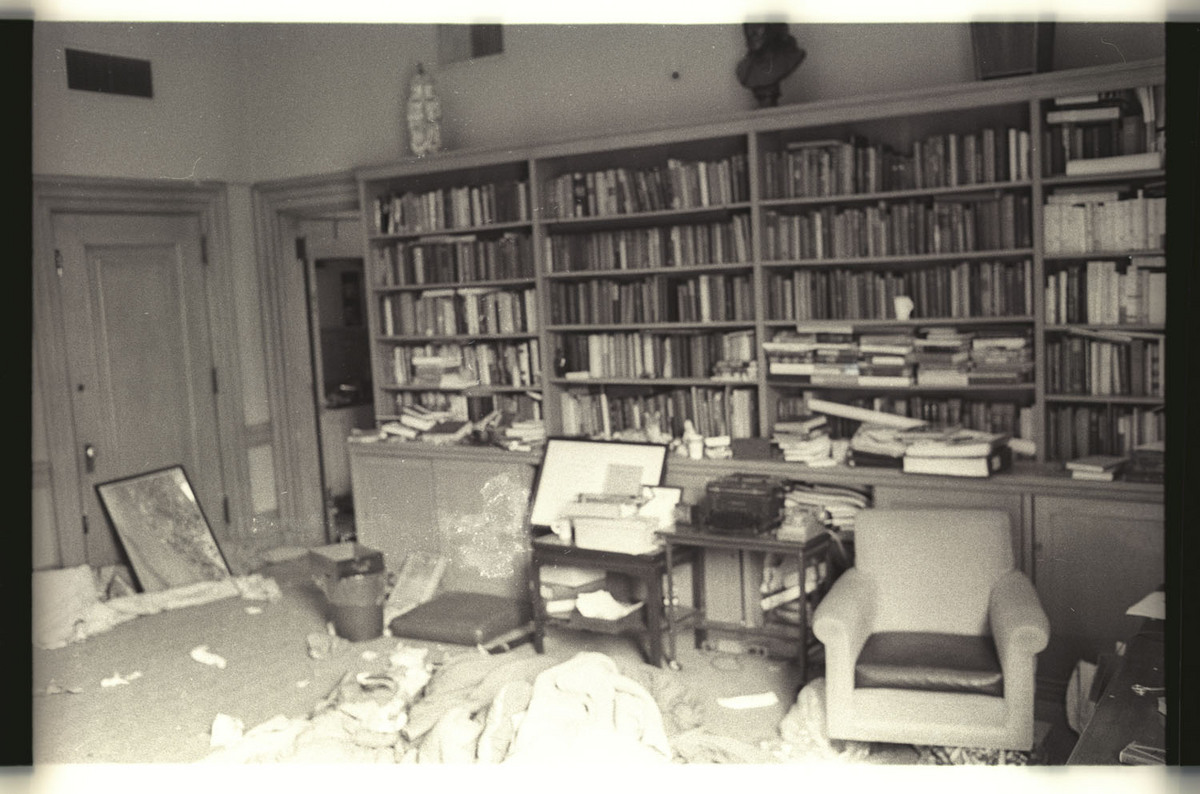
President Kirk's office after the police bust
The Protests: Women's Involvement in the Strike
Over 100 women from Barnard College, the School of General Studies, and the Graduate Faculties participated in the 1968 Columbia protests. A small number of Barnard women had been members of Columbia’s chapter of SDS since its inception. African American Barnard students formed the Barnard Organization of Soul Sisters (BOSS) in 1968; maintaining close connections with the Society of Afro-American Students, BOSS members endorsed the tenets of the Black Power movement, and were among the students occupying Hamilton Hall in April 1968. Barnard women were further galvanized in March of 1968, when student Linda LeClair faced expulsion because the administration discovered that she lived with her boyfriend, a Columbia College student, in an off-campus apartment, and had mislead the Honor Board.
Columbia Daily Spectator article: "Kirk Bans Pickets in CU Buildings," September 25, 1967